How to Choose the Right 3D Printed Bicycle Saddle for Your Product Line
1. Introduction
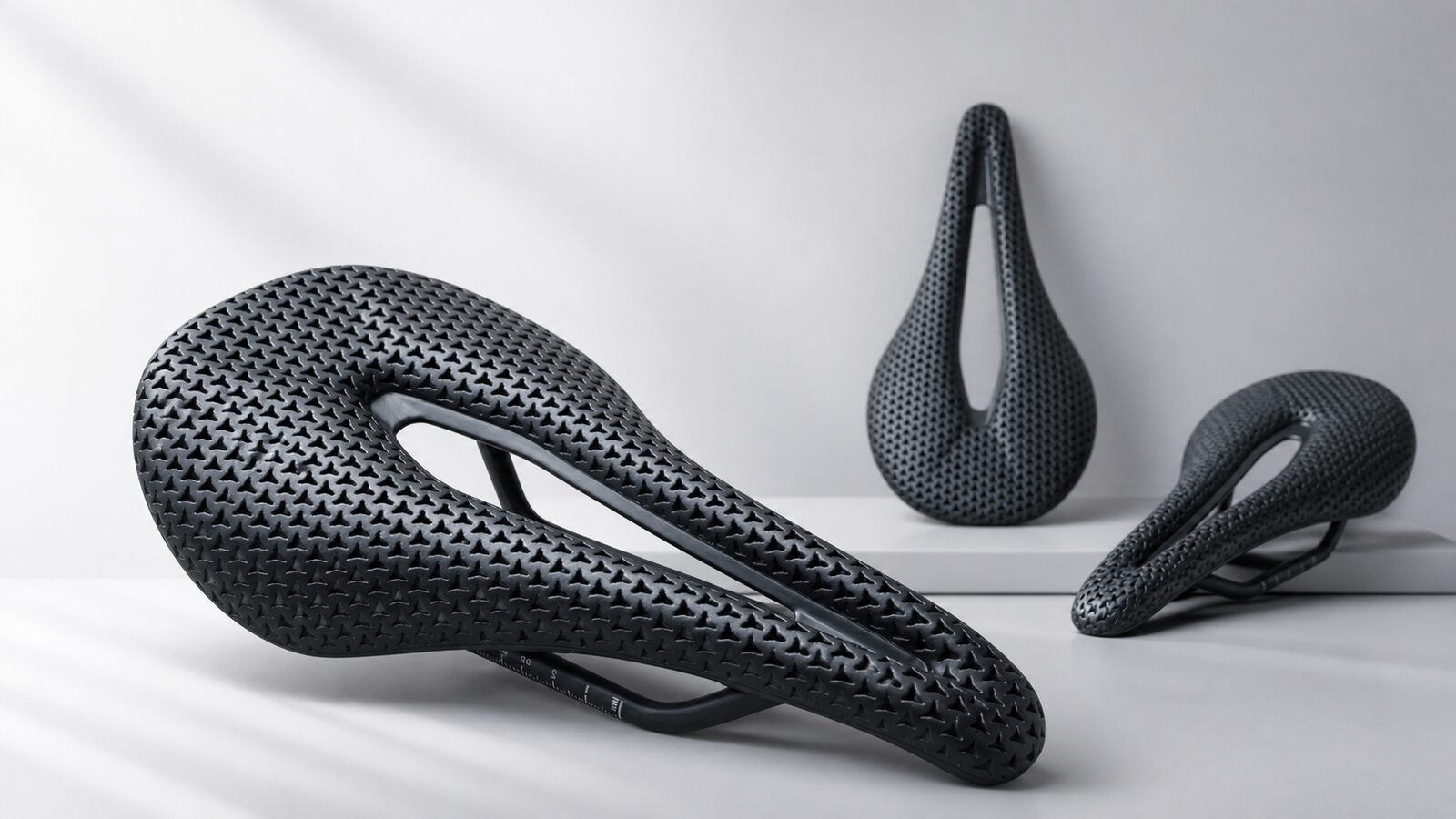
For bicycle brands, distributors, and private label buyers, choosing the right 3D printed bicycle saddle is not only a comfort decision. It is a product-line decision, a rider-fit decision, and a channel decision at the same time. The lattice format has matured to the point where almost every premium and performance lineup is expected to consider it — but the format alone does not guarantee a successful SKU.
The right model depends on what role the saddle plays in your lineup, which rider it is built for, and where it will be sold. A flagship halo platform for a performance brand and a wider comfort-oriented saddle for an e-bike distributor are both valid 3D printed projects, but they require very different geometries, materials, and price logic. This guide walks through the way commercial buyers should structure that choice — from lineup role and rider segment to geometry, channel, shortlist comparison, and pre-RFQ checks.
For a deeper comparison view, see our guide to 3D printed vs conventional saddles for commercial buyers, our breakdown of whether 3D printed bicycle saddles are worth the premium, and our article on how 3D printed bicycle saddles hold up over time.
2. Start With the Role of the Saddle in the Lineup
Before comparing specific models, B2B buyers should define what commercial role the saddle is meant to play. Without that definition, every later decision — geometry, materials, MSRP, branding — becomes harder to justify. Four roles cover most OEM and private label 3D printed saddle programs:
- Flagship / hero SKU — a halo product that anchors the top of the range. Low volume, strong brand impact, used by PR, retail staff, and reviewers as a reference point for the whole lineup.
- Premium upgrade option — sits one tier above the standard saddle on a complete bike or in a brand catalogue, giving customers a clear, visible reason to spend more.
- Versatile core model — a multi-SKU platform that runs across several width or rail variants. Carries volume in the 3D printed tier and provides a stable cornerstone for repeat orders.
- Value-positioned commercial model — a 3D printed option deliberately built to defend a sharper price point, usually with a more efficient base and rail combination, while still keeping a credible lattice story.
Naming the role first makes every downstream sourcing question — material, MOQ, branding scope, MSRP — easier to answer.
3. Match the Saddle to the Target Rider Segment
Different 3D printed platforms suit different riders. The lattice format itself does not change this — width, profile, and intended use case still determine whether the rider stays on the saddle. Most commercial programs serve one or more of these segments:
- Road performance riders — narrower geometry (typically 130–143mm), short-nose or standard-length shells, lightweight carbon construction, race-oriented stiffness.
- Endurance and gravel riders — slightly wider platforms (140–145mm), longer-nose geometry for varied positions, lattice tuned for long-day comfort over outright stiffness.
- Urban and commuter riders — wider, more relaxed shapes with durable rails and finishes, prioritising daily comfort, weather tolerance, and easy cleaning over weight.
- E-bike and comfort-oriented buyers — wider platforms (typically 150–160mm), softer lattice tuning, more pelvic support, geometry built for upright riding positions and longer time in the saddle.
A lineup that serves one of these segments well will almost always outperform a lineup that tries to cover all of them with a single 3D printed model.
4. Geometry and Platform Logic Matter More Than Hype
Lattice imagery looks similar across suppliers. Geometry does not. The structural decisions below the lattice are what actually drive fit, comfort, and long-term acceptance — and they should be locked in before any decision about the cushioning format itself.
- Shape — flat, semi-round, or waved. Determines pelvic rotation freedom and where the rider's weight naturally settles.
- Width — chosen to match the saddle's intended rider segment, not to "look complete" across a range. Most programs need two or three widths, not five.
- Nose profile and length — short-nose for aggressive positions and triathlon, standard length for all-round and endurance use. The nose profile affects perineal pressure as much as the cut-out itself.
- Cut-out and pressure-relief channel — full cut-out, partial channel, or solid lattice. Read the spec, do not assume the lattice replaces the channel.
- Platform logic — whether the model is a single-SKU platform or a base shape that supports multiple width, rail, and finish variants. Multi-variant platforms are usually more efficient for brands that want a coherent 3D printed tier.
When the geometry and platform logic are right for the target rider, the lattice does its job. When they are wrong, no amount of cushioning innovation rescues the sell-through.
5. Choose According to Channel and Price Architecture
The same saddle behaves differently in different channels. The right choice depends as much on where and how the product will be sold as on the product itself. Channel fit affects whether the premium is defendable, how much customer education is required, and how many SKUs the program can realistically support.
- Premium specialist retail — the strongest natural home. Trained staff can translate the lattice story into a confident sale, and the channel rewards visible technology with a defendable retail price.
- Distributor programs — workable when the saddle has a clearly defined slot in the dealer's catalogue (flagship, premium 3D printed tier) rather than competing on entry-level price. SKU complexity should stay tight.
- DTC and branded ecommerce — works well when the brand owns the storytelling and can support content, photography, and rider education at scale. Customer education cost is real and should be planned for.
- Value-oriented OEM projects — usually a poor fit for premium 3D printed platforms. If a 3D printed saddle is required at this tier, the right approach is a deliberately value-positioned model with a tighter spec, not a downgraded flagship.
Channel fit also caps how many 3D printed SKUs a program can sustain. A lineup with three carefully chosen platforms across the right channels typically outperforms a lineup with seven loosely positioned ones.
6. What Buyers Should Compare Across Shortlisted Models
Once two or three models are on the shortlist, comparison should run on the dimensions that actually drive commercial outcomes — not just on weight or lattice photos. A practical framework:
- Weight range — finished-product weight band per configuration, not just a marketing headline number.
- Shell and rail construction — base material (full carbon, carbon-reinforced, nylon-fiber), rail material and diameter, and how the rail-to-shell interface is built.
- Intended use — the rider segment and discipline the platform was designed for, and how that aligns with your target channel.
- Perceived value — how the model presents in the hand, in product photography, and on a dealer wall against the price band you intend to occupy.
- MOQ — minimum order quantity is confirmed per model and configuration during quotation, based on geometry, rail option, and branding scope.
- Repeat-order confidence — how stable lattice geometry, colour, finish, and rail bonding are across batches. Matters more than first-sample price.
- Private label suitability — branding scope (logo, colourway, rail engraving, packaging) and whether the platform supports the level of customisation your program needs.
7. Example Product-Line Logic
Specific models are best understood by the role they fit, not by ranking them against each other. The platforms below are commonly shortlisted in OEM and private label projects, and each tends to fit a particular lineup role and rider segment:
- WKL-2401 — flagship / hero SKU role. Sub-130g full-carbon racing geometry; suits performance brands that need a halo platform to anchor the top of the road range.
- K06 — versatile core model role. All-round road platform built to run as a multi-SKU cornerstone across several width and rail configurations; suits brands building a coherent 3D printed tier.
- K03 — premium upgrade role for endurance and gravel programs. Long-nose geometry and tuned lattice for varied positions and longer days.
- K08 — value-positioned commercial role. Nylon-fiber base and efficient rail option that defends a sharper price point while keeping a credible 3D printed story.
- S27 — wider platform suited to e-bike and comfort-oriented programs, distributor lines that need a clear "comfort 3D printed" SKU, and DTC brands serving endurance and urban riders.
The full range, with specifications and OEM customisation scope per model, is on the 3D printed bicycle saddle page.
8. Common Sourcing Mistakes When Choosing 3D Printed Saddles
Most underperforming 3D printed saddle programs fail on the same handful of mistakes. They are easy to avoid once they are named:
- Choosing by appearance only — picking the model that photographs best instead of the one that fits the rider, channel, and lineup role.
- Ignoring target rider fit — selecting a flagship racing geometry for a comfort-oriented audience, or vice versa. The rider walks away first.
- Overestimating channel willingness to pay — assuming the premium will hold in a channel that competes mainly on price. The result is heavy discounting and protected margin lost.
- Underestimating repeat consistency — focusing on first-sample price instead of how the second, fifth, and tenth production runs will compare.
- Treating every model as premium — running the entire 3D printed tier at flagship pricing instead of differentiating roles across the lineup. The premium story stops being credible.
9. A Simple B2B Selection Checklist
A short, decision-oriented checklist to run through before requesting samples or sending an RFQ. If the answers are not clear, the supplier conversation will not be either.
- Lineup role — flagship, premium upgrade, versatile core, or value-positioned. One role per shortlisted model.
- Target rider segment — discipline, sit-bone width range, and rider expectation (race stiffness, all-day comfort, e-bike support).
- Geometry brief — required width range, nose profile, and length. Two or three widths is usually enough.
- Channel and price band — where the saddle will actually sell, and the retail price band it must defend.
- Volume and timing — first-order quantity, expected repeat cadence, and launch window.
- Branding scope — logo placement, colourway, rail engraving, packaging, and whether co-branded retail packaging is in scope.
- Validation plan — willingness to compare two production-grade samples from different runs before committing volume.
With those answers in hand, a focused supplier conversation usually replaces several rounds of speculative back-and-forth. More on the full sample-to-production timeline is on the OEM development process page.
10. Conclusion
Choosing the right 3D printed bicycle saddle is rarely about picking the most visually striking lattice. It is about matching the model to a clearly defined role in the lineup, a defined rider segment, a channel that supports the intended price band, and a sourcing plan that holds across repeat orders. When those four are aligned, the resulting SKU tends to perform more predictably on margin, sell-through, and shelf life.
Visual novelty alone rarely sustains a program. Product-line role, rider fit, channel logic, and sourcing discipline are what carry it.
Looking for help narrowing down the right 3D printed saddle platforms for your lineup?
Share your target market, target price range, intended channel, and product direction. We can recommend suitable models for your project.
Platforms commonly shortlisted