Production Quality
Quality Control and Production Consistency
Reducing uncertainty across sampling, production, and repeat orders — so that what you approved is what gets delivered, every time.
Why It Matters
The Concerns That Drive Quality Decisions
Sample-to-Production Alignment
The gap between an approved sample and the first production run is where most quality issues begin. We treat sample approval as a binding specification — not a rough reference — so what you reviewed is what gets produced.
Repeat-Order Consistency
Reordering the same model six months later should not feel like a new project. We maintain confirmed specifications, material records, and production references to keep repeat orders aligned with previous deliveries.
Quality Visibility During Execution
You should not have to guess what is happening during production. We provide structured updates and inspection checkpoints so that quality is visible before goods leave the facility — not discovered after arrival.
Inspection Flow
Four Stages of Inspection
Incoming Material Checks
Raw materials — foam, shell substrates, cover materials, rails — are inspected against confirmed specifications before entering the production process.
In-Process Inspection
Key production stages are monitored for dimensional accuracy, bonding quality, cover tension, and alignment with the approved sample standard.
Final Assembly Checks
Finished saddles undergo visual inspection, weight verification, rail alignment check, and surface quality review before moving to packaging.
Packaging / Shipment Review
Packaging integrity, labeling accuracy, carton configuration, and shipment documentation are verified before dispatch.
Sample Approval
Why Approval Before Production Matters
Production quality starts with a clear, reviewed, and confirmed sample — not an approximate reference. Our approval process ensures expectations are aligned before any production commitment begins.
Structured Review Cycles
Samples are developed with defined revision stages. Each iteration is documented and reviewed against your brief before moving forward.
Specification Lock Before Production
Materials, construction details, dimensions, and visual standards are confirmed and locked before production scheduling begins.
Controlled Revisions
Changes requested during sampling are tracked and implemented within the revision cycle — not carried as ambiguity into the production run.
Aligned Expectations
Final sample approval establishes the binding reference for production quality, reducing the risk of misalignment between what was expected and what gets delivered.
Production Consistency
Maintaining Standards Across Orders
Controlled Material Sourcing
Key materials are sourced from confirmed suppliers with established specification records. Changes to material sourcing are communicated and reviewed before implementation.
Process Coordination
Production scheduling, line assignment, and workflow sequencing are coordinated to reduce variability between batches and maintain predictable output quality.
Repeat-Order Stability
Confirmed specifications, production references, and material records are maintained for each project — so repeat orders can be aligned without re-developing from scratch.
Verification and Testing
Quality Verification & Testing
SPROKETO applies structured quality control during bicycle saddle development and production. Our bicycle saddle manufacturer quality process is designed to give OEM buyers, bicycle brands, and distributors clear visibility into how every program is verified before shipment.
Incoming Material Inspection
Raw materials, components, and sourced parts are checked against confirmed specifications before entering production — reducing variability from the start of the bicycle saddle quality control process.
Carbon Rail and Carbon Base Inspection
Carbon-reinforced rails and bases are reviewed for dimensional accuracy, surface integrity, and laminate consistency as part of OEM bicycle saddle testing routines.
3D Printed Saddle Structure Evaluation
Lattice density, bonding zones, and structural uniformity are evaluated on 3D printed bicycle saddle quality assurance runs before assembly approval.
Production Consistency Checks
In-process checks monitor assembly repeatability, weight tolerance, cover tension, and finish quality across batches.
OEM Quality Documentation Support
Inspection records, material declarations, and test summaries are compiled per project so buyers can support their own market and customer requirements.
Third-Party Testing Support When Required
When a program calls for independent verification, we coordinate third-party testing support and provide resulting documentation for the buyer's compliance file.
Testing Reference
EN ISO 4210-2:2023 bicycle safety requirements, with relevant saddle testing methods referenced from ISO 4210-9:2023.
This is a testing reference, not a certification claim. Test documentation is available upon request for qualified projects.
For projects requiring additional verification, third-party testing documentation can be reviewed together with the applicable product configuration and test requirements. See Bicycle Saddle Testing for OEM Buyers for the tested K06 configuration and how to read the report.
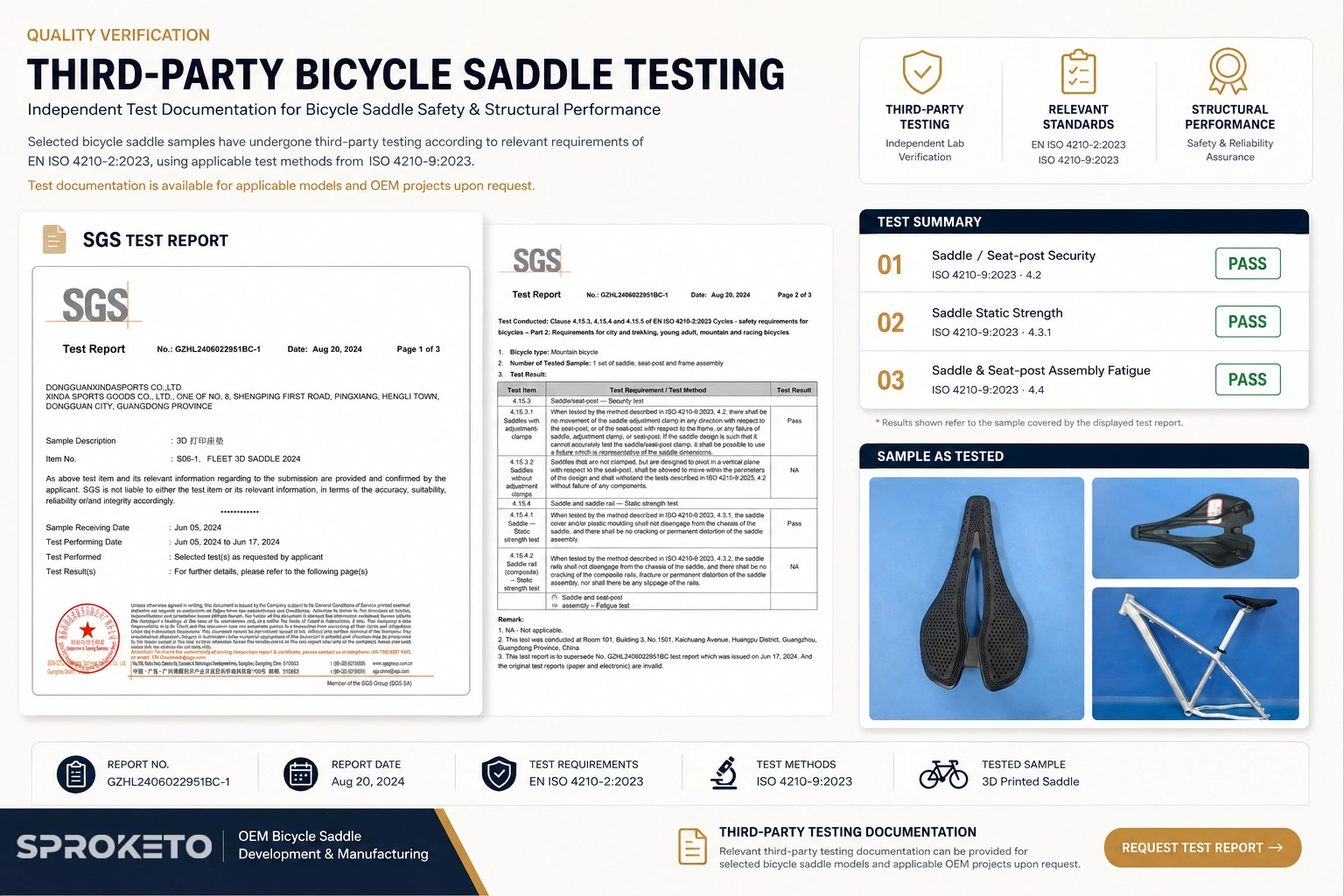
Third-Party Testing Documentation
Selected bicycle saddle models can be supported with third-party testing documentation for relevant safety, structural strength, and fatigue evaluation requirements.
Testing documentation is available upon request for applicable models and OEM projects.
Real test reports and inspection records are shared per project. No generic certificates or marketing claims are used in place of project-specific documentation.
Common Questions
Quality and Consistency — Addressed
Testing and Compliance
Testing Against Recognised Bicycle Saddle Standards
Testing is arranged per project. We do not hold or claim ISO certification — what we provide is third-party testing to the published standards below, with the resulting reports handed to you.
SGS Test Reports
Third-party SGS testing can be arranged for saddle programs. Reports are issued per model and shared with the buyer for their own compliance file and retail documentation.
EN ISO 4210-2:2023 Requirements
Where a project requires it, saddle and seat-post assembly testing can be arranged against the safety requirements defined in EN ISO 4210-2:2023, including saddle security and clamp strength criteria, for the specific saddle configuration.
ISO 4210-9:2023 Test Methods
When arranged, saddle and seat-post tests follow ISO 4210-9:2023 methods — static, fatigue, and clamp tests performed on the tested saddle assembly rather than on the cover alone.
Documentation for Your Program
Test reports, material declarations, and inspection records are compiled per project so brands and distributors can answer their own market and customer requirements.
Standards and testing scope are agreed during OEM development and confirmed before mass production. See our quality control process for in-line and pre-shipment inspection detail.
Third-party testing can be arranged or reviewed based on the specific saddle configuration, project requirements and applicable test methods. Third-party testing documentation is available for a tested K06 configuration — see how the K06 test report is structured.
Need a More Controlled Development and Production Process?
If consistency, inspection rigor, and production coordination matter to your project, we're ready to discuss how we can support your program.
The same quality framework is applied across our 3D printed saddle range, conventional saddles, OEM development, private label programs, and manufacturing capability.