Bicycle Saddle Testing for OEM Buyers: Static Strength, Security and Fatigue Explained
A bicycle saddle can look finished long before an OEM buyer has enough information to approve it for production.
Weight can be checked with a scale. Dimensions can be checked with a caliper. Surface finish and branding can be inspected by eye.
Structural performance is different.
For bicycle brands sourcing saddles, testing helps answer questions that are harder to settle from a sample alone:
- Will the saddle remain secure on the seat-post?
- Can the structure withstand the specified static load?
- Can the saddle-and-seat-post assembly survive repeated loading under the applicable fatigue test conditions?
Those questions become more important as saddle construction becomes more complex.
A modern saddle may combine:
- a 3D-printed upper;
- carbon or nylon base;
- carbon rails;
- bonded or mechanically connected structures;
- different widths and geometries.
For OEM buyers, a test report should therefore be treated as part of the product-evaluation process — not as a logo or certification badge to place on a sales page.
Three saddle tests answer three different questions
Among the saddle-related requirements referenced in EN ISO 4210-2:2023 are requirements covering saddle/seat-post security, saddle static strength and saddle/seat-post assembly fatigue.
They are related, but they do not answer the same question.
A supplier saying that a saddle has “passed testing” is therefore not enough information.
An OEM buyer should know:
- which model was tested;
- which standard and clauses were referenced;
- which test methods were used;
- which requirements were applicable;
- what the recorded result was;
- whether the production product matches the tested construction.
The final point is often the most important commercially.
A passing result on one sample does not remove the need to control materials and production consistency later.
Saddle and seat-post security: does the assembly remain secure?
Security testing addresses a basic but important risk: movement between the saddle and seat-post assembly under the conditions defined by the applicable test method.
For the buyer, the practical question is:
Does the saddle remain securely positioned when the assembly is subjected to the specified test conditions?
This is not the same as checking whether a saddle feels tight after manual installation.
For OEM programs, rail specifications are not interchangeable.
A carbon rail may use different dimensions or clamping requirements from another rail construction. Buyers should therefore confirm rail compatibility early, particularly when the saddle is intended for an existing complete-bike specification.
For background on how rail options relate to product positioning, see carbon and CrMo saddle rail selection.
What an OEM buyer should ask
Instead of asking:
“Has this saddle passed ISO testing?”
Ask:
“Which saddle/seat-post security requirement was tested, on which saddle construction, and using what assembly?”
That question produces information that can actually be compared with the planned bicycle.
Static strength: what happens under a specified high load?
Static strength testing addresses a different issue.
Rather than repeated loading over time, a static test subjects the saddle structure to the conditions defined by the applicable method and evaluates whether the sample meets the stated requirement.
For a buyer, this helps assess the complete structural system rather than just one visible material.
The base matters. The rail matters. The connection between them matters. The geometry matters.
A carbon-base saddle should not be assumed to have adequate static strength simply because carbon is associated with performance products.
Likewise, a nylon-base saddle should not be assumed to be structurally inferior simply because its material cost or market positioning is different.
Testing evaluates the submitted construction. Material labels alone do not.
Fatigue testing: repeated loading is a different problem
A saddle may survive a single static load and still need to demonstrate how the assembly responds to repeated loading.
That is the purpose of fatigue testing.
Fatigue testing evaluates the saddle/seat-post assembly under repeated cycles defined by the applicable method.
For OEM buyers, this matters because bicycles are not subjected to one load event in normal use.
The saddle structure experiences repeated loading throughout its service life.
A fatigue result therefore provides a different piece of evidence from a static-strength result.
Neither should be used as a substitute for the other.
What the K06 third-party test report shows
A useful third-party report should allow a buyer to identify exactly what was evaluated.
One SGS third-party testing documentation record reviewed for this article, dated Aug. 20, 2024, covered the K06 3D-printed bicycle saddle and referenced EN ISO 4210-2:2023 requirements together with applicable ISO 4210-9:2023 test methods.
The report recorded the following applicable results:
K06 — third-party test report summary
| Test area | Tested model | Referenced requirement | Applicable test method | Result |
|---|---|---|---|---|
| Saddle / seat-post security | K06 | EN ISO 4210-2:2023, 4.15.3.1 | ISO 4210-9:2023, 4.2 | Pass |
| Saddle static strength | K06 | EN ISO 4210-2:2023, 4.15.4.1 | ISO 4210-9:2023, 4.3.1 | Pass |
| Saddle / seat-post assembly fatigue | K06 | EN ISO 4210-2:2023, 4.15.5 | ISO 4210-9:2023, 4.4 | Pass |
Not applicable for the K06 sample configuration: 4.15.3.2 — Not Applicable; 4.15.4.2 — Not Applicable.
Other listed requirements, including 4.15.3.2 and 4.15.4.2, were marked not applicable for the K06 sample configuration.
That detail matters.
A report is more useful when it tells the buyer both what applied and what did not, rather than reducing everything to a generic “tested” or “certified” claim.
“Tested to applicable requirements” is not the same as “ISO certified”
This distinction is frequently blurred in supplier marketing.
A third-party laboratory can test a product sample against specified requirements or methods.
That does not automatically mean:
- the manufacturer itself is ISO certified;
- every saddle produced by the company is covered;
- every model in the catalog has been tested;
- every future production batch is identical to the tested sample.
Precise wording is more useful than stronger-sounding claims.
For example:
Third-party testing documentation is available for selected models or applicable projects.
That is more accurate than:
ISO certified saddle factory
unless an actual certification exists and its scope supports that statement.
The same applies to laboratory names.
A report issued by SGS does not automatically make the product or supplier “SGS certified.”
Model identity on the report matters
One of the first things an OEM buyer should check is the sample identification.
A report should provide enough information to connect the result to a specific product or construction.
Useful identifiers may include:
- item or model number;
- sample description;
- construction;
- testing date;
- laboratory report number;
- applicable clauses.
This matters because suppliers may offer visually similar saddles with different:
- bases;
- rails;
- widths;
- geometries;
- internal structures.
A report for one configuration should not automatically be treated as proof for another.
For example, the K06 report discussed above should be understood as documentation for the tested K06 configuration. It should not automatically be treated as covering another model simply because that model also uses a 3D-printed upper or carbon components.
For an OEM development project involving structural changes, the buyer should ask whether existing documentation remains relevant or whether additional verification should be considered.
Why similar-looking saddles may require different evaluation
Two saddles can share a similar 3D-printed upper concept while using different structural platforms underneath.
For example, SPROKETO’s K16 uses:
- 3D-printed upper;
- carbon base;
- carbon rail;
- 250 × 143 mm dimensions;
- approximately 175 g with a stated ±10 g tolerance.
The S160 platform uses:
- 3D-printed upper;
- nylon base;
- carbon rail;
- 7 × 9 mm rail specification;
- 143 mm and 155 mm width options.
Construction examples
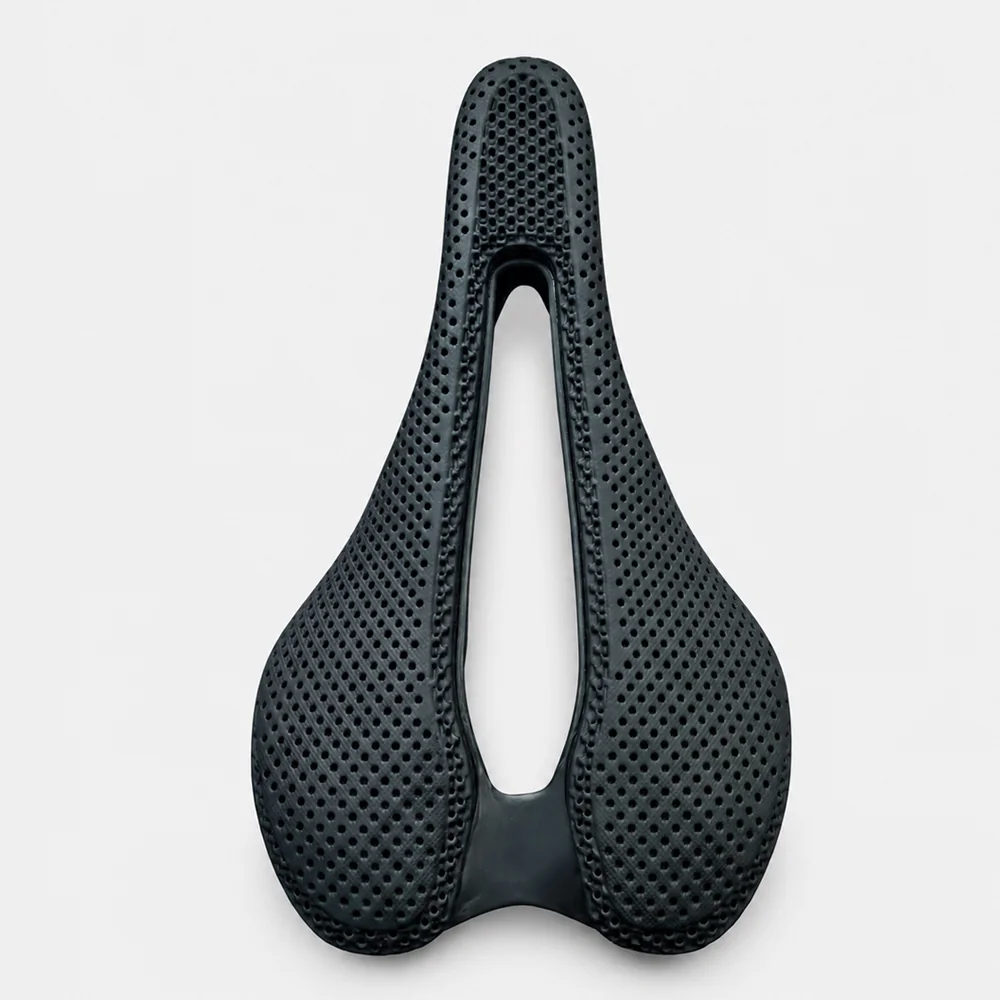
K16
- · 3D-printed upper
- · Carbon base
- · Carbon rail
- · 250 × 143 mm
- · Approx. 175 g ±10 g
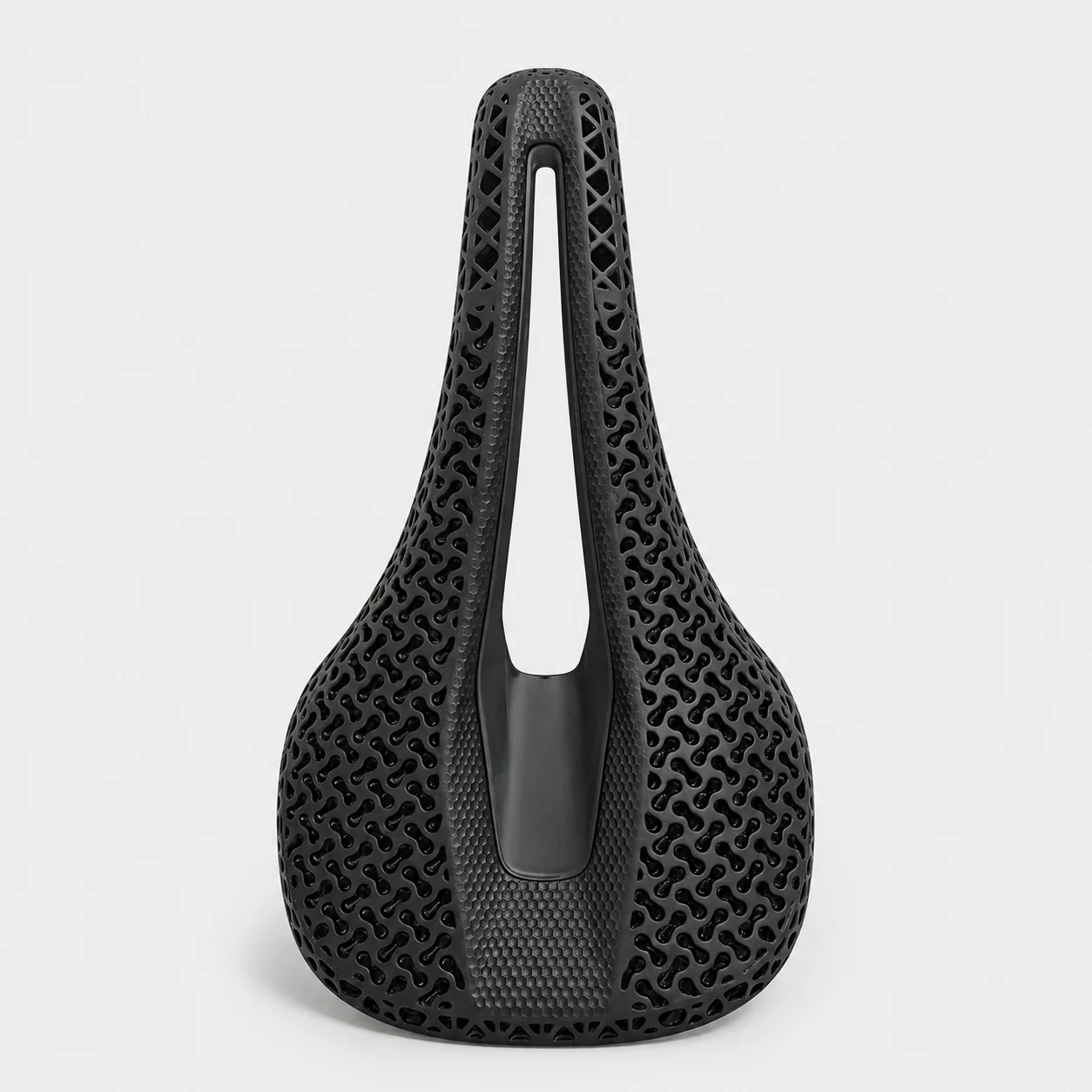
S160
- · 3D-printed upper
- · Nylon base
- · Carbon rail
- · 7 × 9 mm rail
- · 143 mm / 155 mm width options
K16 and S160 are shown here only as examples of different saddle constructions. They are not the test subjects covered by the K06 third-party test report discussed above.
These examples illustrate why model-specific construction matters.
A carbon-base / carbon-rail saddle and a nylon-base / carbon-rail saddle should not automatically be treated as the same structural configuration simply because both use a 3D-printed upper.
K16 and S160 are included here only as examples of different saddle constructions. They are not the test subjects covered by the K06 third-party test report discussed above.
That distinction is important for both buyers and suppliers.
Testing should be connected to sample approval
Laboratory testing is often treated as the last box on a sourcing checklist.
For OEM programs, it is more useful when testing is connected to the sample approval process.
A practical sequence is:
Product brief → sample construction → sample evaluation → applicable testing/document review → approved specification → pre-production confirmation → production QC
This helps prevent a common sourcing problem: approving one configuration and then changing a seemingly small part before production.
A change to the rail, base, reinforcement or interface may affect more than appearance or cost.
It may change the construction on which earlier test evidence was based.
Production consistency is the second half of the problem
Third-party testing provides evidence about the sample submitted for testing.
Production quality control addresses a different question:
Can bulk production remain consistent with the approved construction?
OEM buyers should therefore connect test documentation with production controls such as:
- incoming material verification;
- base and rail specification control;
- dimensional inspection;
- weight tolerance checks where applicable;
- assembly inspection;
- visual standards;
- sample retention;
- pre-shipment inspection.
A laboratory report without production control can leave a gap between the tested product and the shipped product.
Production inspection without relevant product verification leaves a different gap.
Strong OEM programs use both.
3D-printed saddles make traceability more important
The growth of 3D-printed bicycle saddles adds another layer to this issue.
A 3D-printed saddle can combine:
- lattice upper structure;
- base material;
- rail construction;
- geometry;
- bonding or assembly processes.
That gives product developers more variables to work with, but it also means buyers need to be precise about which configuration they are approving.
Changing the lattice is not necessarily the same as changing a logo color.
Changing a rail is not necessarily the same as changing packaging.
OEM development teams should separate cosmetic customization from structural changes and determine when a modification may require additional evaluation.
What should an OEM buyer request from a saddle supplier?
Before approving a bicycle saddle for bulk production, buyers should be able to obtain clear answers from their bicycle saddle manufacturer to several questions.
Which exact model or construction does the testing documentation cover?
The report should be traceable to the product being discussed.
For example, if the report covers K06, buyers should confirm whether the production project uses the same relevant construction before treating that documentation as directly applicable.
Which standard and clauses were referenced?
“ISO tested” is too vague to be useful on its own.
Which test methods were used?
The applicable method provides context for what the result actually represents.
Which requirements were applicable?
A professional report may include both tested items and items marked not applicable.
Who performed the testing?
A recognized third-party laboratory provides independent documentation, but the scope of the report still needs to be read carefully.
Has the project specification changed since testing?
If structural components have changed, the relevance of previous test documentation should be reconsidered.
How will bulk production be kept consistent with the approved sample?
This is where QC procedures become as important as the original laboratory report.
Testing is decision support, not marketing decoration
For OEM buyers, the best use of bicycle saddle testing is not to collect logos.
It is to reduce uncertainty before production.
Security testing helps evaluate whether the saddle and seat-post assembly remain secure under the applicable test conditions.
Static-strength testing examines another aspect of structural performance.
Fatigue testing addresses repeated loading.
Together, they provide buyers with more information than appearance, weight or material descriptions alone.
But the report still needs context.
The buyer needs to know:
- which product was tested;
- which requirements applied;
- which test methods were used;
- whether the production specification remains consistent with the tested configuration.
For the K06 report discussed in this article, the important point is not simply that the applicable items recorded “Pass.”
The more useful information is that the report identifies a specific tested model, specific EN ISO 4210-2:2023 requirements and specific ISO 4210-9:2023 test methods.
That is the difference between having a test report and actually using it in an OEM sourcing decision.
OEM Saddle Quality Questions Before Bulk Production
Before approving a saddle program, consider confirming:
- What exact saddle model does the test documentation cover?
- Are the base and rail specifications the same as the approved sample?
- Which security, static-strength and fatigue requirements were applicable?
- Which test methods were used?
- Is third-party documentation available for review?
- Have any structural changes been made after testing?
- What characteristics will be controlled during bulk production?
- What inspection records or retained samples will be available?
- Does the planned seat-post clamp match the saddle rail specification?
Testing is most useful when these questions are answered before the purchase order becomes a production problem.