Carbon Base vs Nylon Base Bicycle Saddles: What OEM Buyers Should Compare
For bicycle brands developing a new saddle program, the choice between a carbon base and a nylon base is often reduced to a simple assumption: carbon for performance, nylon for cost.
In practice, the decision is rarely that clean.
The base affects weight, stiffness, structural support, manufacturing cost and the position a finished saddle can occupy in a brand’s range. But the base material alone does not determine whether a saddle is appropriate for a premium road bike, an endurance model or a higher-volume private-label program.
Rail construction, saddle geometry, upper structure, reinforcement, target rider, retail price and production requirements all matter.
For OEM buyers, the useful question is therefore not: Which material is better?
It is: Which construction makes sense for the product we are actually trying to develop?
Carbon bases are usually selected when weight and premium positioning matter
Carbon-base saddles are commonly used in performance-oriented programs because they can support lower-weight product targets while fitting the specification expected on higher-end bicycles.
That makes them relevant for road, racing, climbing and premium complete-bike programs where the saddle is expected to contribute to both overall bicycle weight and component positioning.
Carbon also carries a clear market signal. A brand developing a higher-priced bicycle may want the saddle specification to align with the rest of the build: carbon frame, carbon seatpost, performance drivetrain and lightweight cockpit components.
In that environment, a carbon saddle base is not only an engineering decision. It is part of the product architecture.
But a carbon base should not be evaluated in isolation. The finished saddle still depends on the interaction between:
- base structure
- rail construction
- saddle geometry
- upper material
- reinforcement
- manufacturing consistency
A low headline weight does not automatically make a saddle the better OEM platform.
Example: K16 carbon construction
SPROKETO’s K16 is one example of a 3D-printed saddle platform using:
- 3D-printed surface
- carbon base
- carbon rail
- 250 × 143 mm dimensions
- approximately 175g, with a stated ±10g tolerance
The value of this type of construction is not simply that “carbon is better.” It gives an OEM buyer a platform suited to a performance-oriented product brief where carbon construction, weight and premium positioning are part of the specification.
A brand evaluating K16 would still need to consider whether the geometry, width, upper support characteristics and final price point match the intended rider and bicycle category.
Nylon bases serve a broader range of commercial programs
Nylon-base saddles give brands more flexibility when the project is not built around the lowest possible weight. That can include:
- endurance bikes
- recreational products
- e-bikes
- wider-fit saddle programs
- mid-range complete bikes
- private-label products
- higher-volume programs
The term “nylon base” also covers a wide range of engineering outcomes. Base thickness, reinforcement, geometry and material formulation can all change the way the structure behaves.
For that reason, a nylon base should not automatically be treated as a lower-quality alternative to carbon. For some OEM programs, it may simply be the more appropriate platform.
It can allow the brand to manage cost while keeping budget available for other parts of the finished saddle, including:
- carbon rails
- 3D-printed upper technology
- branding
- colors
- packaging
- channel-specific positioning
That tradeoff matters particularly for distributors and private-label buyers. A product does not need the lightest possible construction if its actual commercial job is to deliver a differentiated specification at a viable landed cost.
A nylon base can still be paired with a premium rail
This is one of the reasons buyers should avoid comparing saddles only by base material.
SPROKETO’s S160 platform illustrates the point. The S160 combines:
- 3D-printed surface
- nylon base
- carbon rail
- 7 × 9 mm rail specification
It is offered in two widths:
- S160-143 — 245 × 143 mm, approximately 178g
- S160-155 — 245 × 155 mm, approximately 184g
This is a useful example because the construction does not fit the simplistic formula: carbon = premium, nylon = basic.
The S160 still uses a carbon rail and 3D-printed upper while adopting a nylon base.
For an OEM buyer, that creates another way to structure a product line. A brand may decide that a nylon-base / carbon-rail combination gives the correct balance between:
- product cost
- weight target
- width options
- perceived specification
- rider segment
- retail positioning
That decision should be made from the complete product brief, not from one material name.
The rail specification changes the comparison
Base material is only one part of the structural system.
A carbon-base saddle with carbon rails cannot be directly compared with a nylon-base saddle using another rail specification simply by looking at the base.
The rail affects:
- finished weight
- cost
- clamp compatibility
- product positioning
- structural behaviour
- complete-bike specification
That means OEM buyers should compare the whole platform.
| Factor | Carbon Base | Nylon Base |
|---|---|---|
| Typical positioning | Performance / premium | Broader market / flexible positioning |
| Weight potential | Often lower | Usually more flexible around cost and structure |
| Cost pressure | Higher | More flexible |
| Rail pairing | Frequently carbon in premium programs | Carbon or other rail options depending on target |
| Typical use | Performance road, racing, premium bikes | Endurance, recreational, private label, broader programs |
| Main buyer priority | Weight, premium specification, performance positioning | Cost balance, versatility, scalable product architecture |
This table should be treated as a starting framework, not a purchasing rule.
Two saddles using the same base material can still behave differently because of geometry, thickness, reinforcement and rail design.
With 3D-printed saddles, the base is only one part of the platform
The comparison becomes more interesting with 3D-printed bicycle saddles.
A 3D-printed upper introduces another design variable: the lattice structure and the way support is distributed across different zones of the saddle.
That means an OEM buyer may be balancing at least four major elements at once:
- 3D-printed upper
- saddle base
- rail
- geometry
A premium product may combine a 3D-printed upper, carbon base and carbon rail. Another program may use a 3D-printed upper, nylon base and carbon rail.
Both can be commercially valid. They simply serve different briefs.
Example: 665 as a broader carbon platform
SPROKETO’s 665 uses:
- 3D-printed surface
- carbon base
- carbon rail
- 248 × 148 mm dimensions
- approximately 177g, with a stated ±10g tolerance
Compared with a narrower performance-oriented platform, the 148mm width gives the 665 a different product proposition. An OEM buyer might evaluate it for a program where broader support and a premium carbon specification need to coexist.
Again, the point is not that a carbon base automatically makes the product superior. The point is that the complete geometry and construction create a different product position.
Real platform comparison: K16, 665 and S160
Looking at actual platforms makes the sourcing logic clearer.
| Platform | Surface | Base | Rail | Size | Approx. Weight | Potential OEM Positioning |
|---|---|---|---|---|---|---|
| K16 | 3D-Printed | Carbon | Carbon | 250 × 143 mm | 175g ±10g | Performance / premium |
| 665 | 3D-Printed | Carbon | Carbon | 248 × 148 mm | 177g ±10g | Premium / broader support |
| S160-143 | 3D-Printed | Nylon | Carbon 7×9 mm | 245 × 143 mm | 178g | Balanced performance / commercial flexibility |
| S160-155 | 3D-Printed | Nylon | Carbon 7×9 mm | 245 × 155 mm | 184g | Wider-fit / broader-market platform |
One thing becomes immediately obvious from this comparison: base material does not tell the entire weight story.
The difference between these specific platforms is relatively small compared with the simplistic assumption that every carbon-base saddle must be dramatically lighter than every nylon-base saddle.
Geometry, width, reinforcement and the rest of the structure matter.
That is why OEM buyers should compare actual samples and specifications rather than selecting materials based on category labels alone.
Weight should be treated as a target, not the entire product brief
Weight is easy to compare, so it often dominates early sourcing discussions. A brand can put two samples on a scale and immediately see a difference. But that makes weight unusually easy to overvalue.
For a performance bicycle, a lower saddle weight may contribute to:
- complete-bike weight targets
- premium component positioning
- marketing specifications
- rider expectations
Those are legitimate considerations. But every gram removed does not necessarily create more commercial value.
The better OEM question is whether the complete saddle meets the intended balance of:
- weight
- rider use
- price
- geometry
- structural requirements
- market positioning
- production consistency
A 155mm-wide product should not automatically be judged against a narrower platform purely on weight.
Likewise, a saddle designed for a higher-volume program does not need to chase the specification of a racing-oriented platform if the target buyer values cost and fit differently.
Cost should be evaluated at the complete-product level
The base influences cost, but it is rarely the only cost driver.
A finished OEM bicycle saddle can also be affected by:
- rail material
- 3D-printed upper construction
- saddle width
- branding
- color
- packaging
- order quantity
- tooling requirements
- customization level
- sample development
- testing and documentation requirements
This matters when buyers compare quotations.
A nylon-base platform may free budget for a carbon rail, differentiated upper or stronger packaging presentation. A carbon-base platform may be justified because the saddle belongs on a premium bicycle where the complete specification supports a higher retail position.
So instead of asking only: How much more does carbon cost?
A better sourcing question is: What does changing the base allow us to change about the finished product and its market position?
That leads to a much more useful OEM development conversation.
Sample approval matters more than material labels
Material descriptions are useful during the shortlist stage. Samples matter more before production.
When comparing carbon-base and nylon-base saddle platforms, an OEM buyer should evaluate the complete sample for:
- actual dimensions
- width and geometry
- finished weight
- stated weight tolerance
- rail construction
- upper support characteristics
- visual finish
- branding execution
- rail and base interface
- relevant quality documentation
- production consistency expectations
If several material combinations are being evaluated, it may make sense to test more than one platform with the intended bicycle or rider profile. That is often more useful than trying to decide the material specification entirely from a spreadsheet.
Sample-to-production consistency is another part of the decision
The approved sample should not simply prove that one saddle can be made correctly. It should become a reference point for the production program.
Before bulk production, buyers should confirm which characteristics are being controlled, and how they are verified through quality documentation and inspection, including where applicable:
- base specification
- rail specification
- surface construction
- dimensions
- weight tolerance
- color reference
- branding position
- packaging
- inspection requirements
This becomes particularly important when a saddle combines multiple manufacturing processes and materials.
A strong OEM program needs repeatability, not just an impressive first sample.
There is no universal winner
Carbon bases are well suited to projects where the brief emphasizes:
- lower weight
- performance positioning
- premium specification
- higher-end complete-bike architecture
Nylon bases can be the better choice when the project emphasizes:
- cost flexibility
- broader rider segments
- volume potential
- wider product positioning
- a balanced specification
And products such as the S160 show why the distinction is not binary: a nylon base can still be combined with a carbon rail and a 3D-printed upper.
For OEM buyers, the correct material choice starts with the product brief. Define:
- rider
- bicycle category
- target width
- target weight
- retail positioning
- channel
- expected order volume
- target cost
Then select the base, rail and upper construction that make sense together.
A successful OEM saddle program is rarely built around the material that sounds most advanced. It is built around the material combination that a bicycle saddle manufacturer can deliver consistently.
Example SPROKETO Platforms
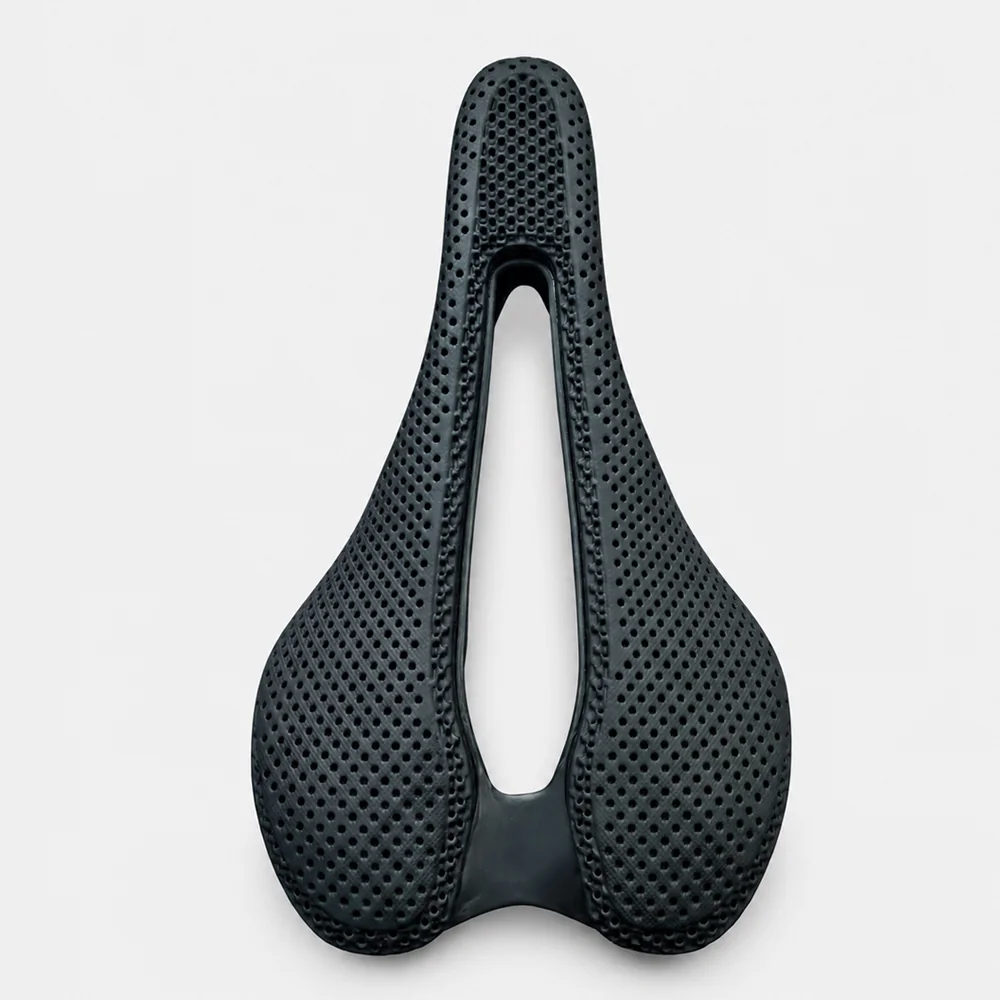
Carbon Base + Carbon Rail
K16
Suitable for performance-oriented OEM projects where carbon construction and premium positioning are priorities.
View Product →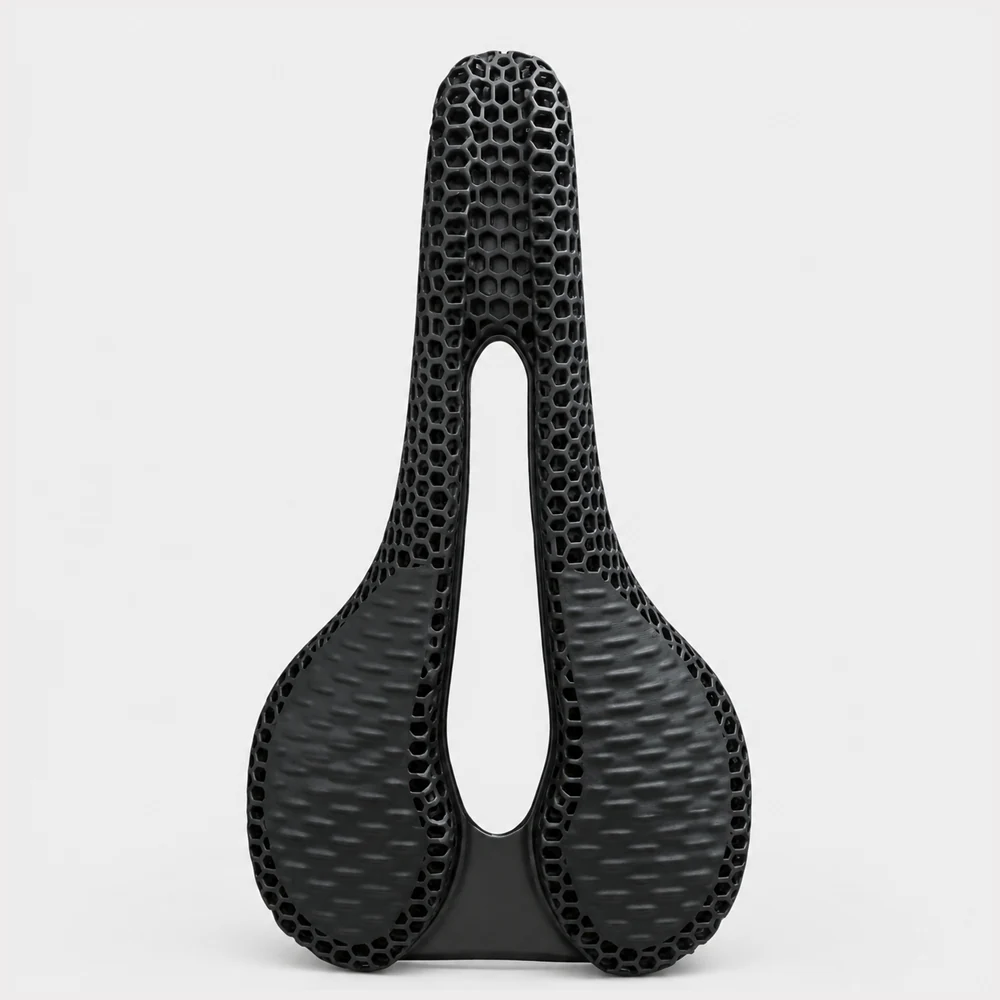
Carbon Base + Carbon Rail
665
A broader carbon platform for brands looking for premium construction with a wider support profile.
View Product →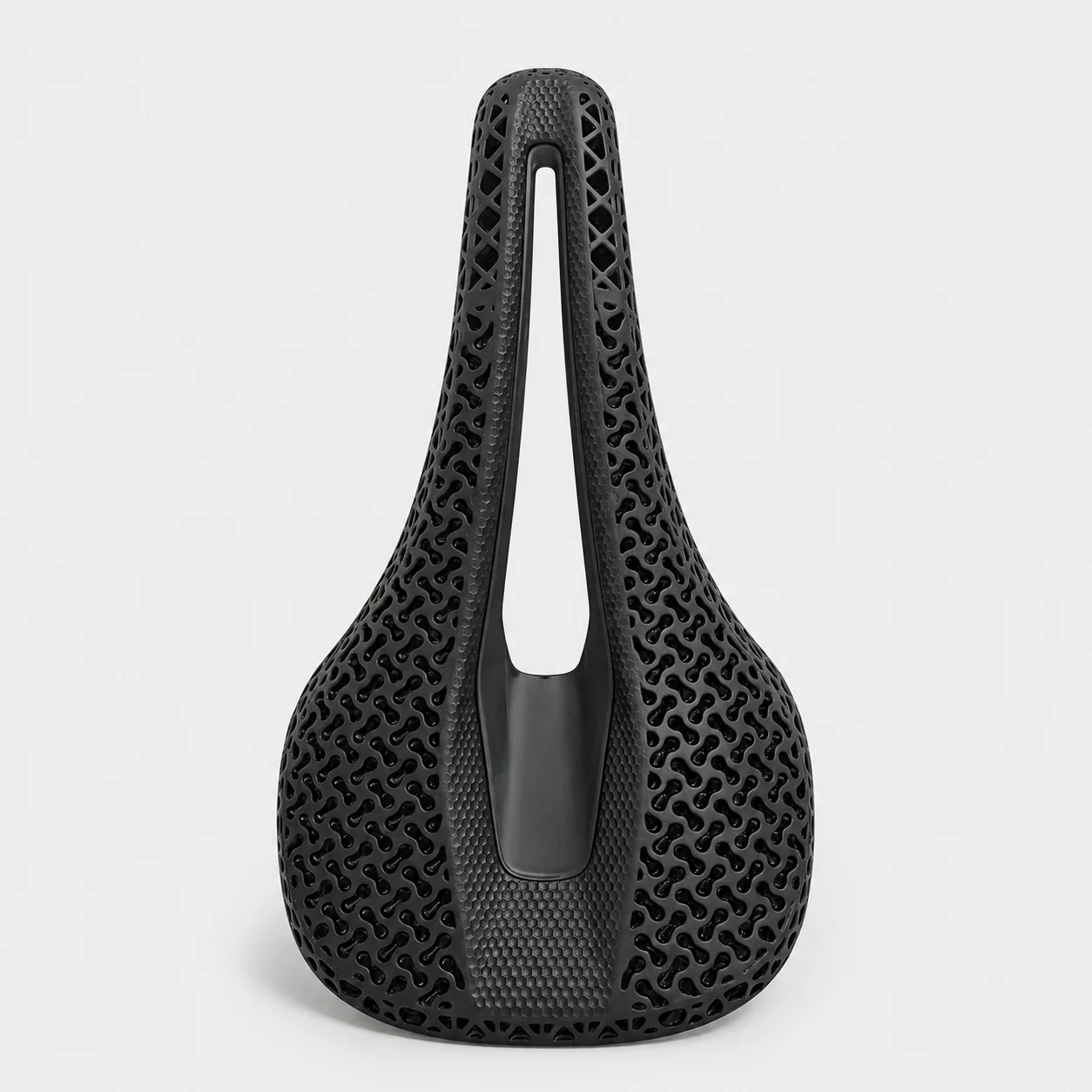
Nylon Base + Carbon Rail
S160
A useful platform for OEM programs seeking 3D-printed upper technology with a nylon base and carbon rail combination.
View Product →Questions OEM Buyers Should Ask Before Selecting a Saddle Base
Is carbon always lighter than nylon?
Not necessarily in every finished saddle. Base material is only one factor. Width, geometry, reinforcement, rail and upper construction also influence finished weight.
Can a nylon-base saddle still use carbon rails?
Yes. A platform such as SPROKETO’s S160 combines a nylon base with a carbon rail.
Should brands choose the lightest sample?
Not automatically. The correct sample should match the target rider, price position, geometry, structural requirements and production goals.
Should carbon and nylon samples be evaluated on the same bicycle?
Where both are being considered for the same product program, evaluating complete samples under comparable conditions can provide more useful information than comparing material specifications alone.
What should be confirmed before bulk production?
Buyers should confirm the approved construction, dimensions, rail specification, weight tolerance, upper specification, branding, packaging and applicable quality requirements before production.