Carbon vs CrMo Bicycle Saddle Rails: How OEM Buyers Should Choose
For bicycle brands and OEM buyers, saddle rail selection is not simply a question of choosing the “best” material.
The right rail depends on the product you are trying to build.
A lightweight premium saddle, a mid-range distribution model and an entry-level private-label saddle may require very different rail strategies, even when they are developed from a similar saddle platform.
For many OEM projects, buyers may consider:
- Carbon rails for lightweight and premium positioning
- CrMo rails for a more conventional metal-rail configuration
- A lower-cost bend-formed tubular rail option for selected entry-level programs
These options should not be treated as direct replacements for one another.
They support different combinations of product weight, target price, market positioning and development complexity.
This guide explains how OEM buyers should evaluate saddle rail options from a product-development and sourcing perspective.
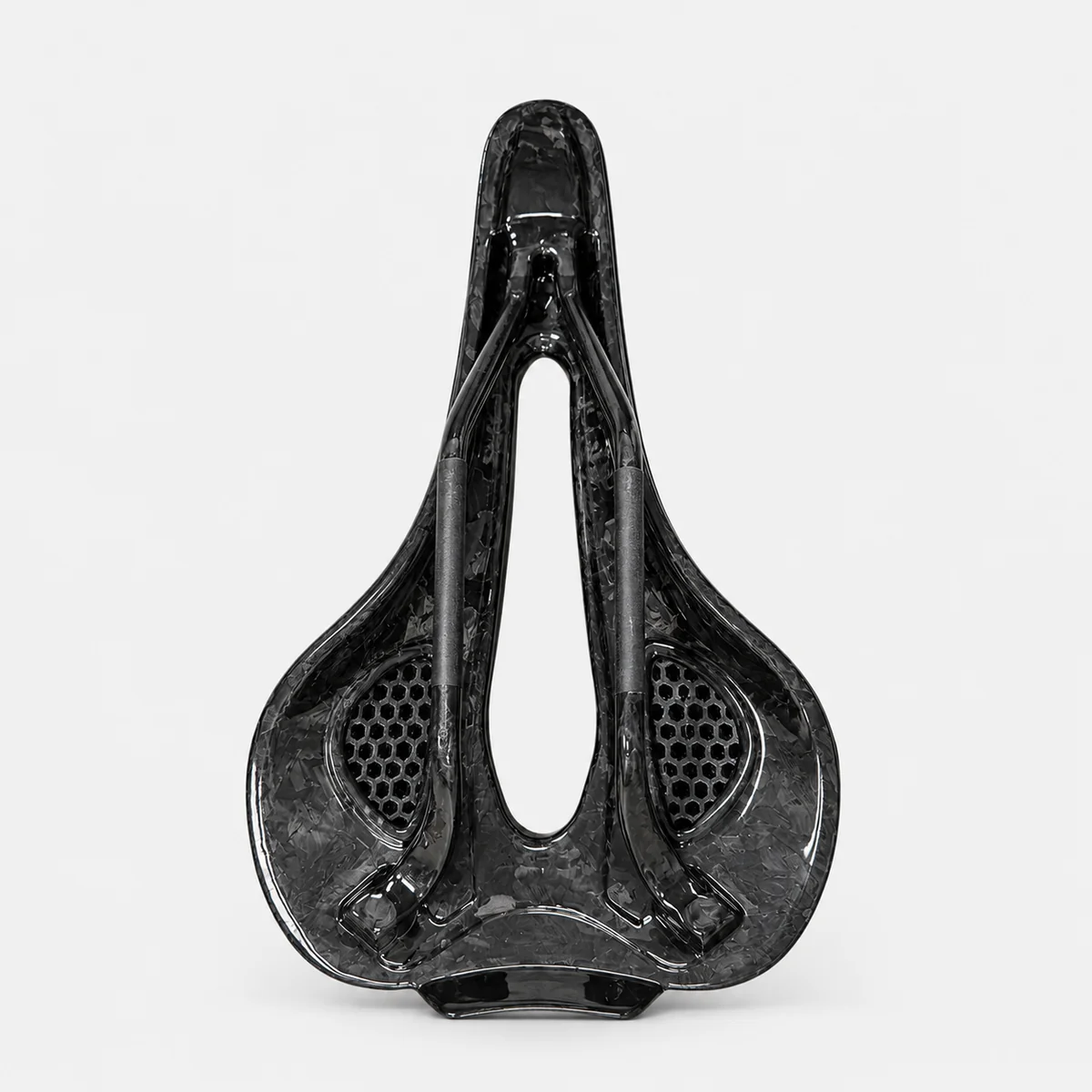
Quick Comparison: Carbon, CrMo and Lower-Cost Tubular Rail Directions
| Rail Direction | Typical Product Positioning | Weight Direction | Cost Direction | Development Consideration |
|---|---|---|---|---|
| Carbon rail | Premium / lightweight | Lightweight-oriented | Higher-cost direction | Rail, base and connection structure should be evaluated together |
| CrMo rail | Mid-range / conventional metal configuration | Higher than a lightweight carbon direction | More accessible than carbon in many projects | Mature metal-rail direction, but exact specification still matters |
| Bend-formed tubular rail | Entry-level / cost-sensitive | Higher-weight direction | Lower-cost direction | For this approach, the rail can be formed by tube bending without a dedicated rail mould |
This table is a sourcing and product-positioning guide, not a universal engineering specification.
Actual weight, cost and performance depend on the complete rail specification, geometry, saddle structure, production process and testing requirements.
1. Carbon Rails: When Low Weight Supports Premium Positioning
Carbon rails are usually considered when total saddle weight and premium positioning are important parts of the product brief.
This makes carbon particularly relevant for:
- performance-oriented saddle ranges
- premium 3D printed saddles
- lightweight OEM programs
- higher retail price segments
- products where weight is part of the commercial positioning
However, OEM buyers should avoid evaluating a carbon rail in isolation.
The rail is only one part of the saddle system.
The final saddle depends on the interaction between:
- rail geometry
- rail section
- saddle base
- rail-to-base connection
- saddle dimensions
- surface construction
- target complete saddle weight
- testing requirements
For this reason, the more useful question is not:
“How light is the carbon rail?”
It is:
“What complete saddle weight and market position are we trying to achieve?”
A lightweight rail does not automatically create a well-developed lightweight saddle.
The base structure, connection method and complete product architecture still need to work together.
For OEM buyers evaluating lightweight saddle platforms, SPROKETO’s 3D printed bicycle saddle platforms include multiple configurations using different base and rail combinations.
2. CrMo Rails: A Conventional Metal-Rail Direction
CrMo rails are another established direction for bicycle saddle development.
Compared with carbon, CrMo typically supports a different product strategy.
It may be relevant when the buyer wants:
- a conventional metal rail
- a more accessible product configuration
- a mid-range saddle program
- a product where minimum possible weight is not the primary goal
- a second configuration below a premium carbon version
From an OEM perspective, the important point is that “CrMo rail” alone is still not a complete product specification.
Buyers should also confirm:
- rail geometry
- rail dimensions
- tubular or other construction
- rail-to-base interface
- surface treatment if applicable
- complete saddle weight target
- testing requirements
A material name alone does not define the complete saddle.
This matters particularly when a brand wants to use one saddle concept across different price levels.
For example, a premium version may use carbon rails while another configuration may use a metal rail.
That creates a product family rather than forcing one specification to serve every market segment.
3. A Lower-Cost Bend-Formed Tubular Rail Option for Entry-Level Saddles
For selected cost-sensitive OEM projects, a lower-cost tubular rail can also be considered as an alternative development direction.
The key advantage is not simply the material.
The important difference is the forming method.
For the development approach discussed here, the tubular rail is formed by tube bending according to the required geometry.
Because the geometry is created through tube bending, there is no need to develop a dedicated rail mould for this specific approach.
This can help reduce initial development complexity and cost.
It may therefore be relevant when the buyer wants:
- an entry-level saddle configuration
- a lower-cost version of a premium saddle concept
- a broader market price range
- a price-sensitive private-label program
- lower initial rail-development cost
However, this option should not be positioned as a lightweight alternative to carbon.
Its commercial purpose is different.
The trade-off is that the final configuration will generally move toward a higher product weight than a lightweight carbon-rail version.
The benefit is a more economical product direction.
No Dedicated Rail Mould Does Not Mean No Production Control
This distinction is important.
For this bend-formed tubular rail approach, no dedicated rail mould is required.
However, this does not mean that production requires no tooling or process control.
Depending on the design, production may still require:
- bending fixtures
- jigs
- gauges
- dimensional controls
- process checks
The purpose is to maintain geometry and production consistency, which is also why these points should be reviewed together with quality control requirements during development.
OEM buyers should therefore distinguish between:
“no dedicated rail mould”
and:
“no production tooling or process control”
They are not the same thing.
4. The Exact Tubular Rail Specification Must Still Be Confirmed
A lower-cost tubular rail should not be treated as a finished engineering specification until the project requirements are defined.
Before production, the following may need to be confirmed:
- exact material specification
- tube dimensions
- wall thickness
- rail geometry
- bending radius
- surface treatment
- rail-to-base connection
- target complete saddle weight
- testing requirements
- expected production quantity
This is why the final rail should be reviewed together with the saddle drawing rather than selected independently.
For an OEM project, the product target should come first.
The detailed rail specification should follow.
5. One Saddle Concept Can Support Different Market Positions
One of the most useful OEM strategies is to stop thinking about carbon and metal rails as direct competitors.
They can instead support different versions of the same product concept.
A typical product architecture might be:
Premium Version
- Carbon rail
- Lower total saddle weight
- Premium positioning
- Higher target retail segment
- Performance-oriented application
More Economical Version
- Metal rail configuration
- Higher total saddle weight
- Lower cost direction
- Broader price-sensitive market
- Entry-level or value-oriented positioning
CrMo may sit between these directions depending on the project.
This should not be treated as a rigid industry hierarchy.
The final position depends on the complete saddle design, weight target, rail specification, production cost and selling strategy.
For OEM buyers, the important question is not:
“Which rail is best?”
The better question is:
“Which rail configuration fits the target product and target price segment?”
This approach is particularly useful for brands that want to create multiple SKUs from a shared saddle concept.
Instead of developing completely unrelated saddles for every price point, different rail and structural configurations may allow the brand to build a clearer product family.
Compatibility must still be evaluated during development.
6. Start With the Product Brief, Not the Rail Material
A common sourcing mistake is to select the rail material before defining the product.
A stronger OEM development process starts with the commercial brief.
Before selecting the rail, define the following.
Target Market Position
Is the saddle intended for:
- premium performance
- mid-range distribution
- entry-level retail
- private-label online sales
- mass-market distribution
Target Complete Saddle Weight
Do not define only the rail weight.
Define the target for the complete saddle.
This gives the development team a much more useful engineering target.
Target Cost
Weight and cost need to be evaluated together.
A very aggressive cost target combined with a premium lightweight specification may create an unrealistic development brief.
Saddle Platform
Confirm whether the project will use:
- an existing saddle platform
- a modified existing platform
- a fully customized development
This can significantly affect development cost and timing.
Rail Geometry
The rail needs to work with:
- the base structure
- the connection points
- saddle dimensions
- intended seat-post interface
- complete product design
Testing Requirements
The complete saddle assembly should be evaluated according to the requirements relevant to the project.
Rail material alone does not demonstrate complete saddle performance.
For more information, see Bicycle Saddle Testing for OEM Buyers.
7. Can One Saddle Platform Use More Than One Rail Configuration?
Potentially, yes.
In some OEM projects, one saddle platform may support multiple commercial configurations.
For example:
- Version A: carbon rail
- Version B: metal rail
This can help a brand develop different price points around a shared product concept.
However, buyers should not assume that one rail can simply be replaced by another without engineering review.
The following still need to be checked:
- rail geometry
- saddle base structure
- rail-to-base interface
- connection method
- dimensional compatibility
- final product weight
- testing requirements
The correct approach is to evaluate each configuration as part of the complete saddle.
8. Prototype and Tooling Decisions Should Follow the Final Geometry
For customized saddle projects, development should follow a controlled sequence.
A typical process may include:
- Confirm the target product
- Finalize and review the drawings
- Review saddle and rail geometry
- Confirm development and tooling scope
- Confirm development cost
- Produce a prototype
- Evaluate and approve the prototype
- Proceed with tooling
- Produce the first moulded sample
- Review the production specification
This sequence helps avoid starting tooling before the key geometry and product direction are agreed.
For custom projects, SPROKETO reviews the drawings and development scope before tooling begins as part of OEM bicycle saddle development.
9. What Should an OEM Buyer Include in a Saddle RFQ?
Instead of sending an inquiry such as:
“We need a carbon saddle.”
A useful OEM RFQ should provide enough information to evaluate the complete product.
Useful information includes:
- target market
- target retail positioning
- intended bicycle application
- saddle dimensions
- target complete saddle weight
- preferred rail direction
- preferred base material
- surface construction
- expected order quantity
- customization requirements
- testing requirements
- target cost range
This makes it easier to determine whether a carbon, CrMo or another tubular rail configuration is suitable.
It also reduces unnecessary sampling and repeated specification changes. Buyers who want to understand the production scope of a bicycle saddle manufacturer can review that background before preparing the RFQ.
Final Takeaway
Carbon, CrMo and lower-cost tubular rail configurations solve different product-development problems.
Carbon is most relevant when lightweight and premium positioning are important.
CrMo provides a conventional metal-rail direction for projects where absolute minimum weight is not the main priority.
For selected entry-level projects, a bend-formed tubular rail can offer a more economical development direction, and for this specific approach, no dedicated rail mould is required.
The strongest OEM approach is to define the target product first and select the rail configuration second.
The decision should consider:
- complete saddle weight
- target price
- market positioning
- saddle structure
- rail geometry
- development complexity
- testing requirements
If you are developing a bicycle saddle program, send us your target saddle weight, price segment, preferred rail direction and expected order quantity.
SPROKETO can review the platform configuration and help determine which development direction is suitable for your project.
FAQ
Are carbon bicycle saddle rails always better than metal rails?
No. Carbon rails are useful when low weight and premium positioning are priorities, but metal rails may be more suitable for products where cost, market positioning or product architecture are more important than minimum possible weight.
What is the difference between a carbon rail and a CrMo bicycle saddle rail?
Carbon rails are typically selected for lightweight and premium saddle configurations, while CrMo rails provide a conventional metal-rail direction. The final choice depends on the complete saddle design, weight target, rail specification, cost target and testing requirements.
Does a bend-formed tubular saddle rail require a dedicated mould?
For the bend-formed tubular rail approach described in this article, no dedicated rail mould is required. The rail is formed by tube bending according to the required geometry. Production may still require appropriate fixtures, jigs, gauges and process controls.
Can the same bicycle saddle platform use both carbon and metal rails?
Potentially, yes, but compatibility must be confirmed during development. Rail geometry, saddle base structure, rail-to-base connection, dimensions, complete saddle weight and testing requirements need to be reviewed together.
What information should I provide for an OEM bicycle saddle quotation?
Provide the target market, intended application, saddle dimensions, target complete weight, preferred rail direction, base material, surface construction, expected order quantity, customization requirements, testing requirements and target cost range.
Developing a Bicycle Saddle Program?
Send us your target saddle weight, market position, preferred rail direction and expected order quantity. We can review the platform configuration and help identify a suitable development direction.