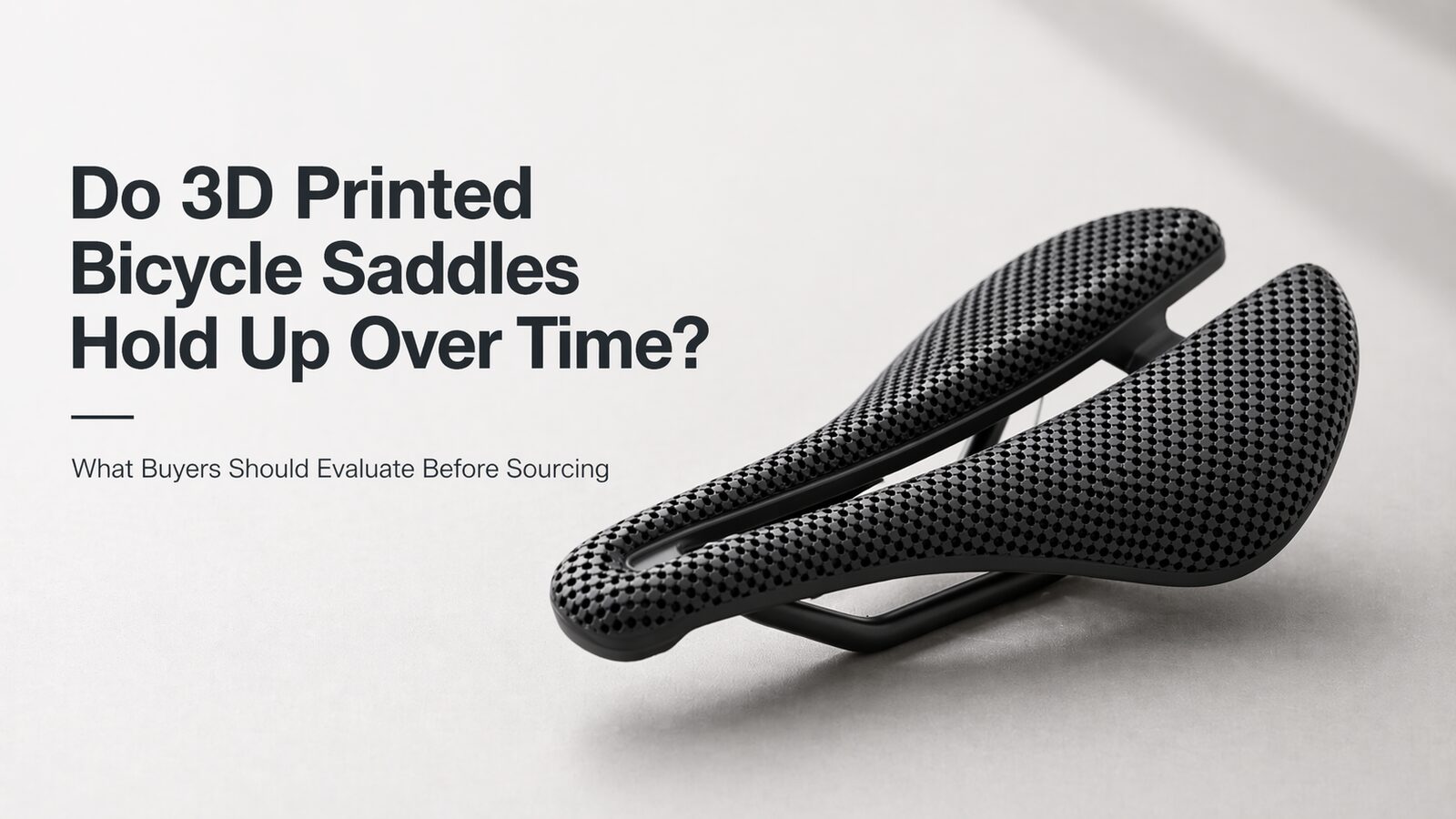
Do 3D Printed Bicycle Saddles Hold Up Over Time? What Buyers Should Evaluate Before Sourcing
1. Introduction — Why This Question Matters at the Sourcing Stage
For bicycle brands, distributors, and private label buyers evaluating 3D printed bicycle saddles for an OEM or private label program, "do they hold up over time?" is rarely a curiosity question. It is a sourcing question — and the answer directly shapes which models belong in the lineup, how they are positioned in the channel, and how confident the brand can be in repeat orders.
Most B2B buyers approaching this category for the first time want clear answers on three things before they sign off on volume:
- Field life — how the saddle behaves after a full season of real customer use, not just on a shop wall.
- Repeat consistency — whether the second and third production runs match the first, batch after batch.
- Commercial fit — whether the durability story actually translates into stronger sell-through in the target channel.
This guide is structured around those three concerns. It explains what long-term durability really means for 3D printed saddles in a B2B context, what to evaluate before placing an order, and how to read a supplier conversation the way an experienced sourcing team does. Background on why this category is on so many shortlists is in why more bicycle brands are paying attention to 3D printed saddles, and the parallel pricing logic is covered in are 3D printed bicycle saddles really worth the premium.
2. Why Durability Questions Matter in Commercial Sourcing
For end consumers, durability is mostly about personal experience. For commercial buyers, durability translates directly into business risk. Four areas in particular deserve attention.
Return risk. Saddles that lose their original feel, finish, or appearance too quickly tend to drive return rates upward — especially in premium price bands where customer expectations are higher.
After-sales risk. Warranty claims, replacement coordination, and handling field complaints all consume operational time. The more durable and consistent the product, the lower the after-sales overhead for the brand and its distributors.
Brand reputation. A premium saddle that ages badly in customer photos, reviews, or social posts can quietly erode brand perception over time. For private label sellers in particular, the saddle becomes a direct extension of the brand story.
Lineup stability. Models that hold up well across seasons can stay in the catalog longer, support repeat purchases, and serve as anchor SKUs in a multi-year product strategy. Models that age poorly need to be refreshed or replaced more often, increasing development load.
3. What "Durability" Actually Means for 3D Printed Saddles
Durability is not a single property. For 3D printed bicycle saddles, it is a combination of several distinct behaviours, each worth evaluating on its own:
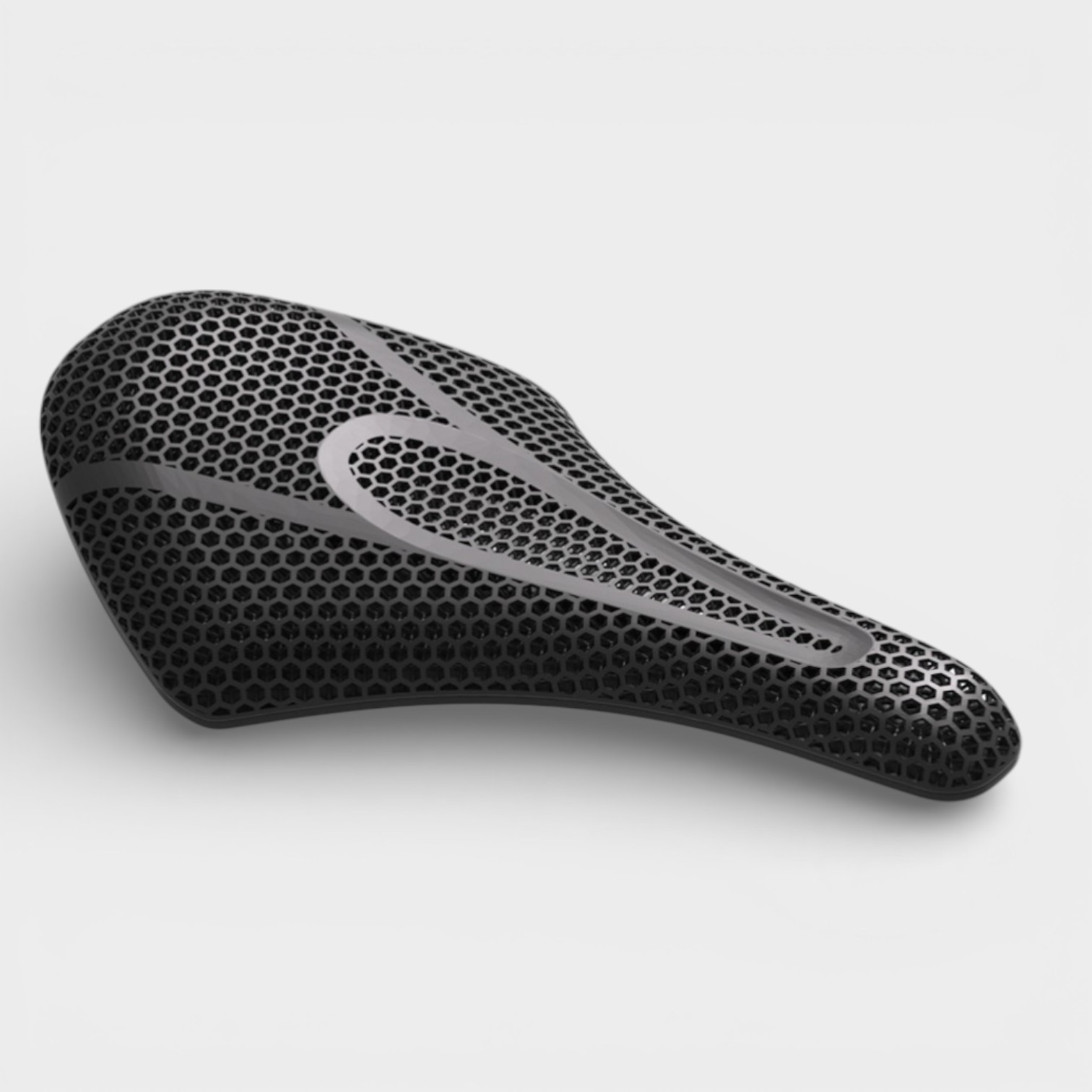
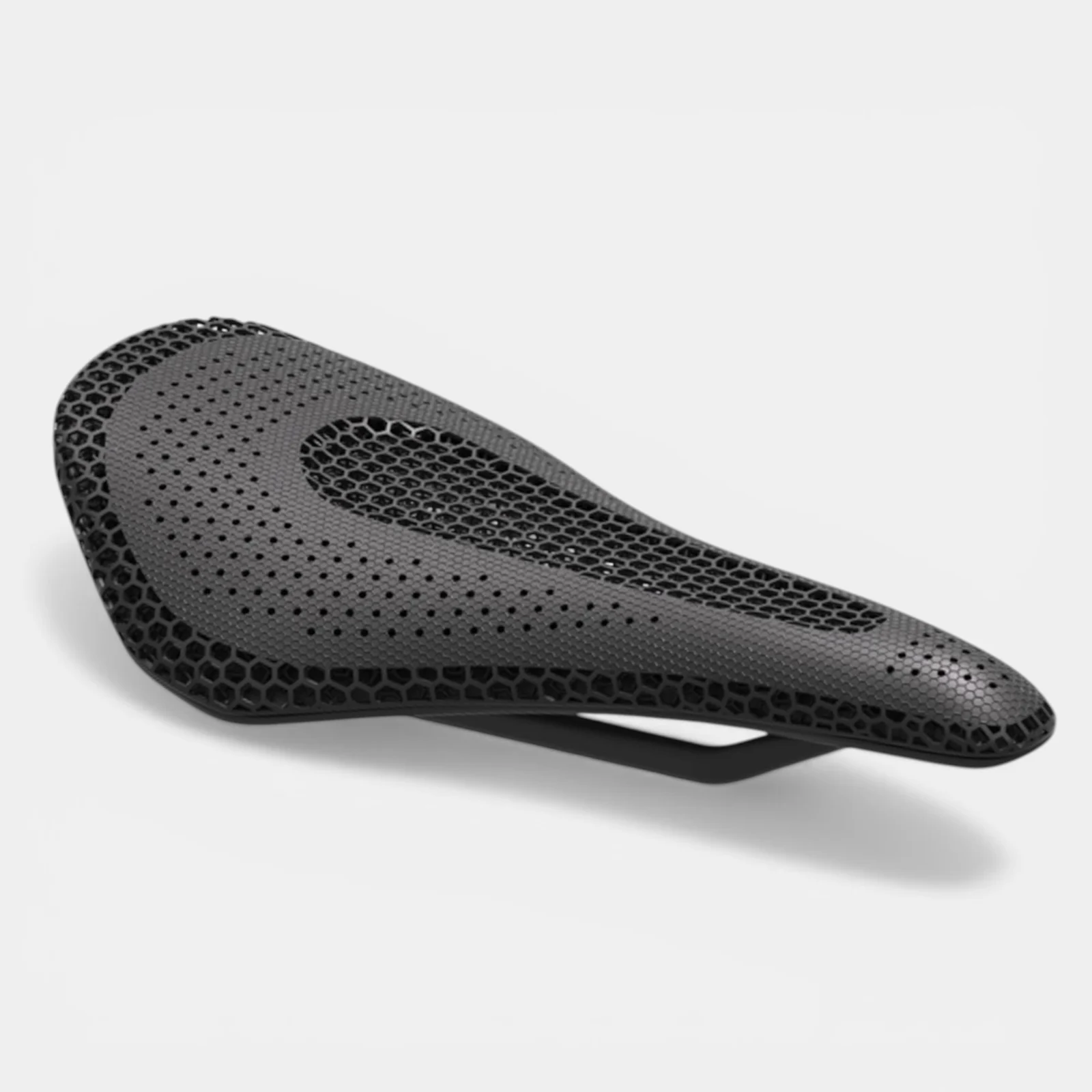
- Surface resilience — how well the lattice surface resists abrasion, scuffing, and contact wear from kit, gloves, bike racks, and storage. This is what keeps a saddle looking premium after months of real use.
- Compression retention — how well the lattice maintains its original cushioning and rebound after long seated hours and full-season use. Strong compression retention keeps the saddle feeling close to its as-new state for far longer.
- Structural consistency — how stable the saddle remains at the shell, the lattice-to-shell interface, and the rail-to-shell bond. This is the difference between a saddle that quietly continues to perform and one that develops creaks, soft spots, or visible weak points.
- Cleaning and maintenance — how easily the saddle can be cleaned in real customer conditions, and how the surface and structure respond to repeated cleaning cycles, sweat, and common bike cleaners.
- Appearance retention — how the saddle looks after extended UV exposure, sweat contact, and seasonal use. Often what end customers notice first, even before they consciously evaluate comfort or structure.
- Daily use vs aggressive use — a 3D printed saddle on a road bike used a few times per week behaves very differently from the same saddle on a commuter or gravel bike in all weather. Match each model's expected lifecycle to the realistic usage profile of the target customer.
4. Material and Construction Factors Buyers Should Evaluate
Long-term performance is largely determined at the design and construction stage. Four factors deserve close attention during shortlisting:
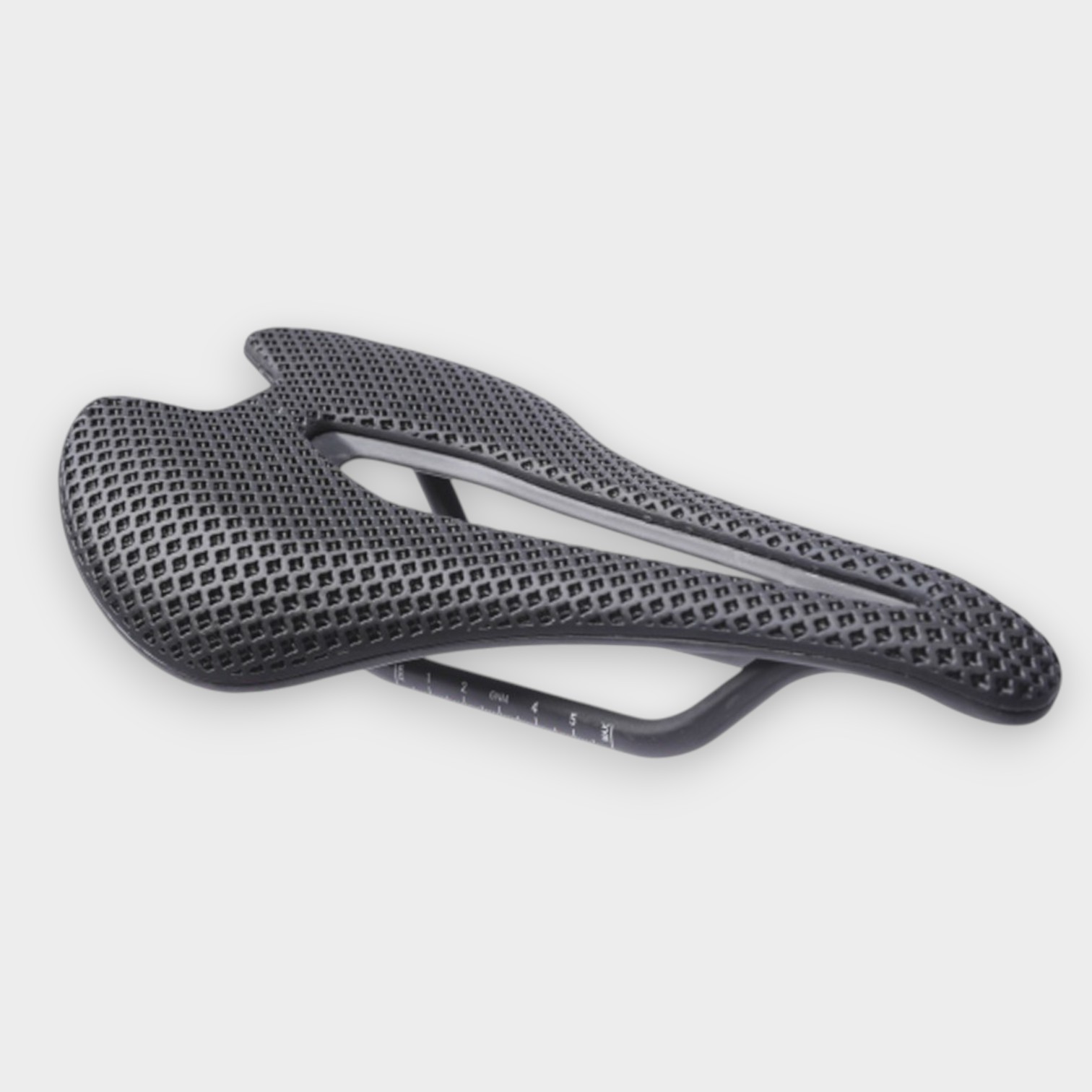
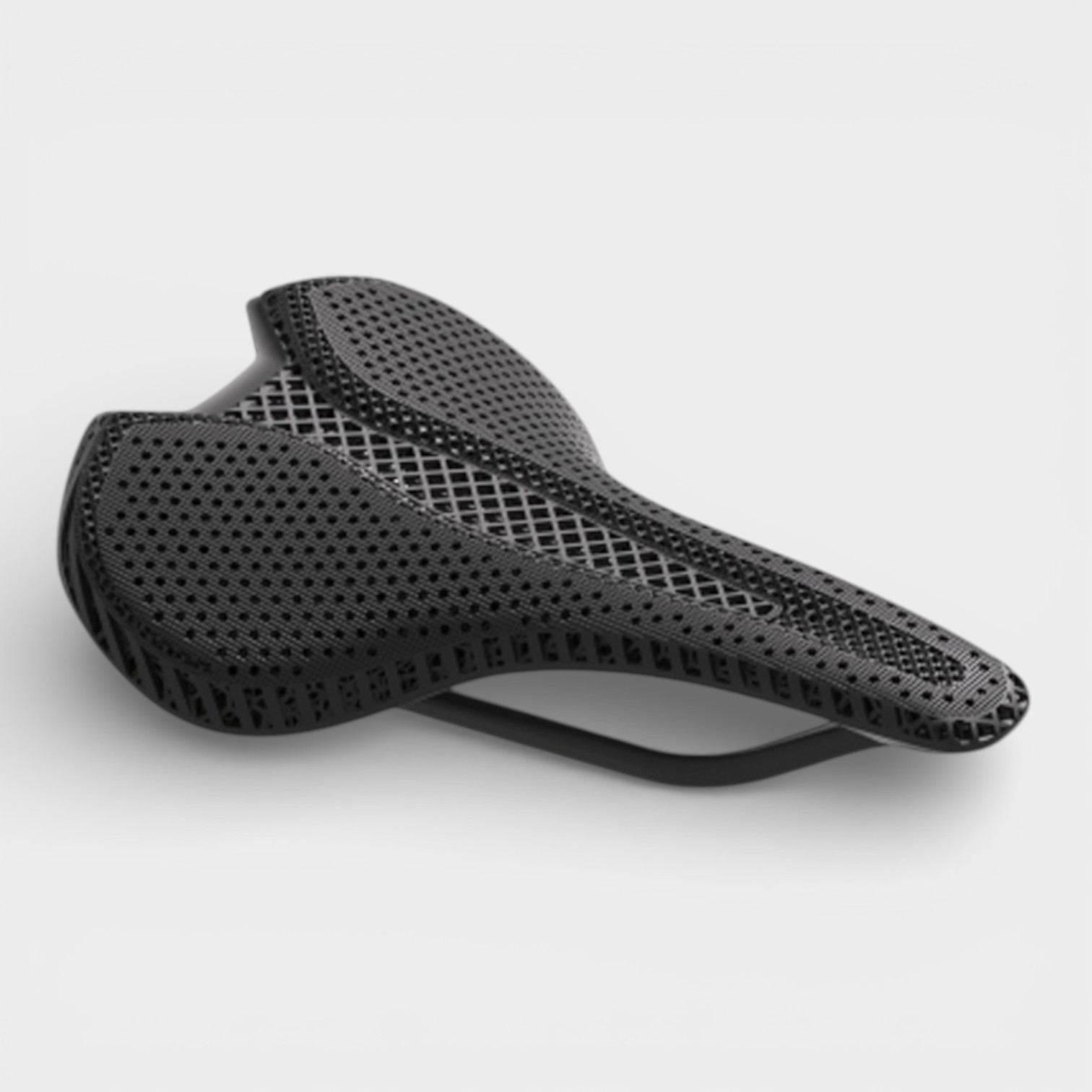
- Lattice design — geometry, density distribution, and material formulation define how the saddle absorbs load, recovers between rides, and ages under repeated compression. A well-designed lattice supports comfort zones without creating weak points where the structure fatigues first.
- Shell structure — the foundation under the lattice. Its stiffness profile, edge transitions, and material (nylon composite, carbon-reinforced, or full carbon) strongly influence how the saddle flexes over time and how stable the lattice support remains.
- Rail material and interface — CrMo, titanium, or carbon rails each carry different fatigue behaviour. The rail-to-shell interface is the quiet durability factor; premium models like the WKL-2401 are engineered with this integration in mind.
- Position in the product range — a flagship hero model is typically engineered with more conservative tolerances and more rigorous structural validation than a mid-tier alternative. A full-carbon all-round platform like the K40 sits between the two, balancing weight and durability for multi-season road programs. Matching the model to its intended product tier is part of building a stable long-term lineup.
5. Why Sample Evaluation Matters Before Bulk Ordering
For a category as visually expressive and structurally engineered as 3D printed saddles, sample evaluation is a critical step. It gives buyers the chance to validate the product against the realities of their channel before committing volume. Useful checks during the sample round:
- Test riding — ride the actual sample, do not only inspect it on a desk. This reveals how the lattice behaves under real load, how the cushioning feels over a longer ride, and whether the ride character matches your target rider.
- Handling feel — pick up the saddle, flex it gently, and feel the surface. Premium products should feel premium in the hand, not only in the photo.
- Visual consistency — inspect lattice geometry, edges, and surface across multiple angles. Small irregularities tend to become more visible after weeks of use.
- Finish quality — check lattice openings, shell edges, rail bonds, and branding areas. Finish is the first place where rushed production reveals itself.
- Channel fit — confirm the saddle suits the channel it is being sourced for. A model right for a specialty performance store may not be right for a high-volume value channel, even with similar specs on paper.
6. Sample-to-Bulk Consistency: The Decisive B2B Question
For commercial buyers, a perfect sample is not the goal. A perfect sample that can be reproduced at scale is. Sample-to-bulk consistency is where most 3D printed saddle programs either succeed quietly for several seasons or develop slow, expensive problems in their second and third orders. It deserves to be evaluated as its own decision criterion, not as an afterthought.
The B2B risk is asymmetric. A first sample is usually built with extra attention; bulk runs reveal whether the supplier's process — not just their best operators — can hold the same standard. When sample and bulk diverge, the cost lands on the brand: returns, warranty handling, dealer complaints, and quiet erosion of the premium story the saddle was sourced to support.
Before committing to volume, structured buyers typically validate the following:
- Multi-sample comparison — request two or three production-grade samples from different runs, not just a single show-piece, and compare them side by side.
- Lattice and dimensional tolerances — ask for the per-batch tolerance ranges on lattice geometry, shell thickness, and rail spacing, and confirm how those tolerances are documented.
- Colour and surface stability — confirm batch-to-batch behaviour on colourway, surface finish, and any branded markings, ideally with reference samples from previous production runs.
- Rail bonding QC — clarify the inspection step that governs the rail-to-shell bond, the pass criteria, and how rejected units are handled inside the line.
- Pre-shipment inspection — confirm what is checked on every unit vs sampled per carton, and whether the report is shared with the buyer before container release.
- Repeat-order behaviour — ask how the same SKU is run on its second, fifth, and tenth production cycle. A supplier with a real answer to this question is a different sourcing partner than one that focuses only on the first sample.
These checks are part of the wider OEM development process and are the strongest predictor that the durability story you validated on the sample will still be true two seasons into the program.
7. Questions Buyers Should Ask Suppliers Before Sourcing
A short, structured supplier conversation can prevent most long-term sourcing surprises. The following questions are particularly useful for 3D printed bicycle saddle projects.
- Target rider and use case. Which rider segment and use case is this model designed for? Road, gravel, performance, urban, or all-rounder?
- Weight range expectations. What is the typical finished weight range for this model, and how consistent is it across production?
- Care recommendations. What are the recommended cleaning methods, allowed cleaners, and storage conditions for long-term use?
- MOQ and repeat consistency. What is the realistic MOQ, and how is consistency maintained between repeat production runs of the same model?
- Design consistency between batches. What process controls govern lattice geometry, color, and surface finish across batches?
- Private label feasibility. Which models support private label customization (logo, color, packaging, branded rail engraving), and at what minimum order level?
A supplier that answers these questions clearly — not just enthusiastically — is usually a stronger long-term partner. This is the kind of structured alignment that sits at the heart of any solid OEM development process.
8. When 3D Printed Saddles Are Easier to Justify Commercially
Long-term durability matters more — and is easier to monetize — in product lines where the saddle plays a meaningful commercial role. The clearer the channel narrative, the easier it is to defend the price point and protect margin over multiple seasons. 3D printed bicycle saddles tend to fit naturally in the following commercial contexts.
- Premium road lines where weight, refinement, and visible innovation directly support the price ladder and give the sales floor a clear story to tell.
- Gravel product ranges where long-day comfort, structural confidence, and a modern visual identity help justify a higher attach rate on complete bikes and aftermarket upgrades.
- Modern performance categories where the buyer profile already expects engineered components, not commodity parts, and is willing to pay for visible technology.
- Innovation-led product launches where a 3D printed saddle reinforces the message of a new flagship platform and gives PR, retail staff, and reviewers something concrete to point to.
- Specialty and performance retail channels where staff can explain the value, fit the product to the rider, and convert the durability story into repeat business.
In these contexts, the durability story is also a brand story. A saddle that holds up well over time becomes an active asset to the lineup — anchoring repeat orders, supporting multi-season catalog stability, and reducing the pressure to constantly refresh the hero SKU.
9. When Buyers Should Be More Cautious
There are also contexts where 3D printed saddles deserve more careful evaluation before being added to the lineup. In each case, the limiting factor is rarely the product itself — it is the channel's ability to translate the premium into a confident sale.
- Price-sensitive channels where the buying decision is driven mostly by sticker price, not perceived value — here, a strong conventional saddle usually delivers better sell-through.
- Weak premium positioning where the brand or seller cannot clearly explain why this saddle is worth more than a conventional alternative, leaving margin exposed to discounting.
- Unclear target users where the rider profile, riding discipline, and intended use case have not been defined yet, making it hard to match the right model to the right shelf.
- Channels without product-education capacity — pure-volume marketplaces or thin-margin distribution where there is no one to translate the technology into a buying reason.
In these situations, even an excellent 3D printed saddle can underperform commercially. The right move is often to start with a focused pilot SKU in the strongest channel, validate the sell-through story, and then expand the lineup once the commercial case is proven.
10. Conclusion
Most quality 3D printed bicycle saddles do hold up well over time when the material, shell, bonding, and production controls are right. The deeper question is not whether the technology can perform, but whether a specific model fits the commercial role it is being sourced for.
For commercial buyers, long-term suitability should be evaluated commercially, not just visually. Surface resilience, compression retention, structural consistency, cleaning behavior, and appearance retention all matter — but they only translate into business value when they line up with the target rider, the channel, and the role of the product in the lineup. When that alignment is in place, a 3D printed bicycle saddle can be a confident long-term sourcing decision rather than a high-visibility risk.
Three related guides are worth reading alongside this one: are 3D printed bicycle saddles really worth the premium works through the pricing and channel logic, why bicycle brands are paying more attention to 3D printed saddles covers the positioning and product-line strategy behind the category, and 3D printed vs conventional saddles for commercial buyers compares both formats side by side. To go straight to product, the 3D printed saddle range lists every model currently available for OEM and private label projects.
11. Buyer FAQ
How long should a well-made 3D printed bicycle saddle realistically last?
With a properly engineered lattice, validated shell, and clean rail bonding, a quality 3D printed saddle is built to deliver multiple seasons of regular use without losing its core ride character. Actual lifespan depends on rider weight, usage intensity, and storage conditions — which is why we recommend matching each model to a clearly defined rider segment rather than positioning it as a universal product.
Are 3D printed saddles harder to support after the sale than conventional ones?
Not when sourced from a partner with consistent batch-to-batch production. The areas that drive after-sales load — rail alignment, shell integrity, surface finish, and color consistency — are all manageable with the right process controls. Buyers should ask suppliers directly how these are governed across repeat orders, and request reference samples from earlier production runs.
Can 3D printed saddles be private labeled and customized like conventional models?
Yes. Most 3D printed platforms support logo placement, color variants, branded rail engraving, and custom packaging, subject to model-specific MOQs. The key is to confirm customization scope and minimum order levels at the briefing stage so the program fits the channel's launch plan rather than being retrofitted later.
Planning a 3D printed saddle program? Let's run through it together.
Share your target market, price band, channel, and launch timing. We will recommend a short list of platforms suited to the role, walk you through sampling, MOQ, and lead times, and explain how we hold sample-to-bulk consistency across repeat orders. No obligation to commit — a working sourcing conversation, structured the way OEM and private label buyers actually evaluate suppliers.
Durability-tested platforms buyers commonly evaluate