What Bicycle Brands Should Know About MOQ, Sampling, and Lead Time Before Sourcing 3D Printed Saddles
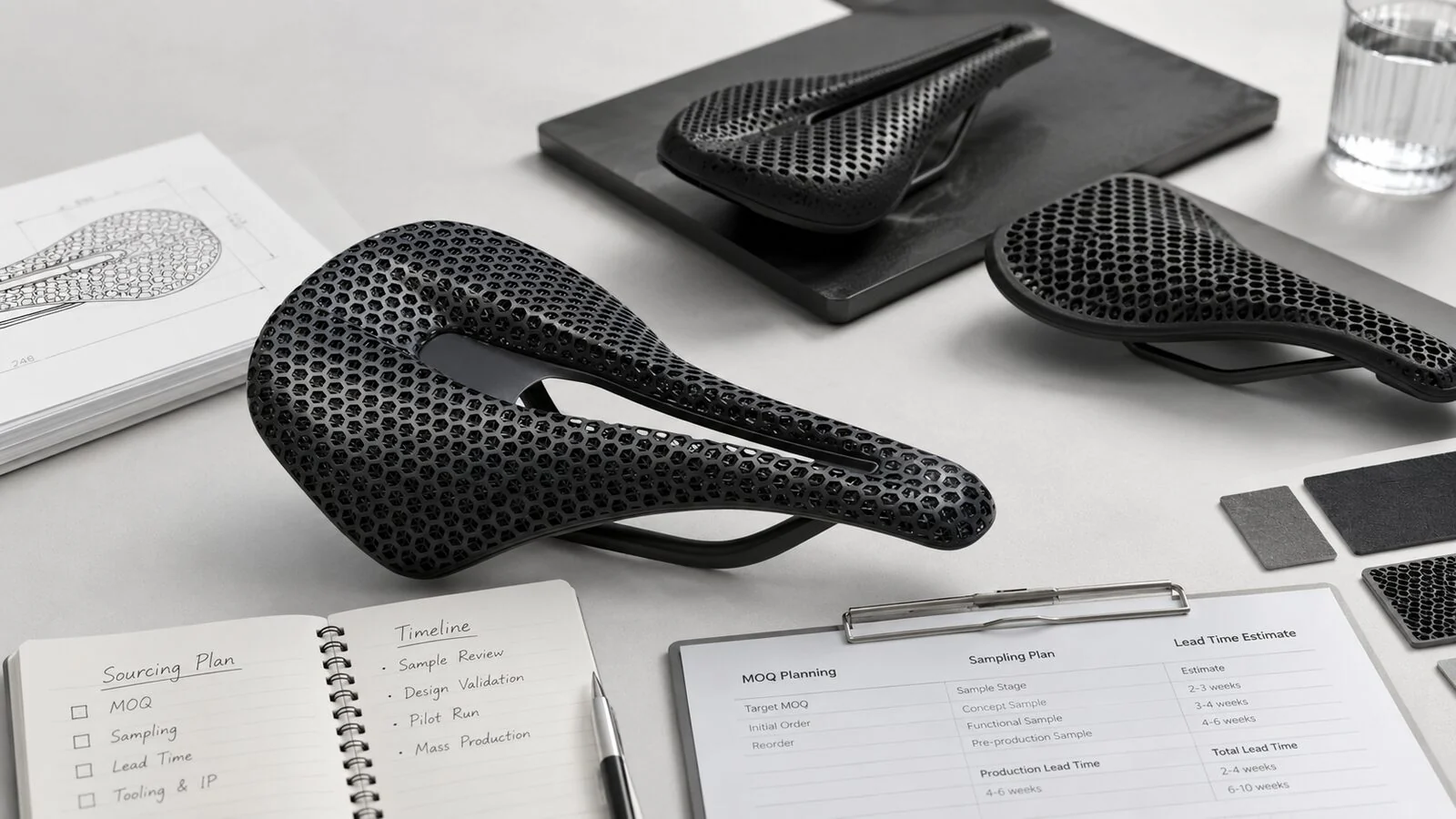
For bicycle brands, distributors, and private label buyers evaluating 3D printed bicycle saddles, MOQ, sampling, and lead time are usually the three questions that decide whether a project is actually workable. They look like administrative details, but in practice they shape model selection, pricing logic, branding scope, and launch timing.
They are also the three areas where assumptions cause the most friction. A buyer who treats MOQ as a single factory number, sampling as a formality, or lead time as a fixed value tends to lose weeks before the first production run is even scheduled. This guide is written for commercial buyers who want a clearer view before sending an RFQ.
1. What MOQ Really Means in 3D Printed Saddle Sourcing
The 3D printed bicycle saddle MOQ is rarely one number. It is a function of model, base and shell combination, rail option, branding scope, and how customised the project is. A stock platform with a standard rail and minimal branding sits at one MOQ band. The same platform with a custom colourway, branded rail engraving, and co-branded retail packaging usually sits at a higher one.
Buyers also need to think in terms of commercially realistic MOQ rather than the lowest possible quantity. A first-order quantity that is too small to amortise setup, branding, and quality validation typically results in a higher unit price, a lower priority slot in the production schedule, and a weaker basis for repeat-order pricing. A pilot quantity is useful for validation; it is not the same as a long-term program quantity, and the two should be planned separately.
Private label bicycle saddle MOQ follows the same logic. The more the SKU diverges from a stock platform — custom shell shape, exclusive lattice, full retail packaging — the more the minimum order quantity reflects that. Buyers running a private label program tend to get cleaner quotes when they define branding scope before asking for MOQ.
2. Why Sample Evaluation Matters Before Bulk Ordering
A single 3D printed bicycle saddle sample is a starting point, not a decision. Serious sourcing decisions usually require evaluating samples against the role the SKU will play in the lineup, not only how it feels on a single test ride. One sample tells you the model exists; two or more across runs tell you whether it is sourceable at scale.
When evaluating a 3D printed saddle sample, commercial buyers should look at:
- Geometry and fit — width, length, nose profile, and how the shape sits under the intended rider segment.
- Lattice feel — pressure distribution, rebound, and whether the comfort zones match the brief.
- Structure and finish — rail bonding, base stiffness, lattice surface quality, and visible tolerances.
- Commercial fit — packaging-ready appearance, branding placement, and how the SKU photographs for retail or DTC channels.
- Repeat-order confidence — willingness to compare a second sample from a different production run before committing volume.
Sampling is not only about comfort. It is about whether the sample can be reliably reproduced in bulk. Buyers who validate this once tend to avoid the most expensive sourcing mistakes later. The quality control process behind those repeat runs is what holds sample-to-bulk consistency in place.
3. Typical Lead Time Expectations for OEM and Private Label Saddle Projects
For existing platforms — for example K40, K06, S27, or WKL-2401 — sample lead time is generally short because the underlying tooling and lattice data already exist. Most stock-platform samples can be prepared in a clearly defined window once branding and configuration are confirmed.
Production lead time for a confirmed program typically sits in the 25–40 day range for stock platforms with standard customisation, and longer for projects that require custom shell work, new lattice tuning, or co-branded retail packaging. The OEM bicycle saddle production lead time is influenced by order quantity, branding complexity, rail option availability, and the production calendar at the time of confirmation.
The most useful distinction for buyers is between stock-platform customisation (existing geometry, custom branding and colourway) and more customised projects (new shell, exclusive lattice, full packaging program). The first runs on a predictable timeline. The second carries an extra development window before any production lead time begins. The full process is described on the OEM development page.
Buyers should plan around launch timing and internal approval cycles rather than around the supplier window alone. Internal sample sign-off, marketing asset preparation, and channel-loading dates are often the gating items, not the factory schedule.
4. What Usually Delays 3D Printed Saddle Projects
Most slipped timelines on 3D printed saddle projects are not caused by the supplier alone. The recurring patterns are familiar:
- Unclear model role — the SKU is sourced before its role in the lineup is defined.
- Late geometry changes — width, length, or rail spec changes after sampling has started.
- Unclear branding scope — logo, colour, and packaging decisions arriving piece by piece.
- Sample approval delays — internal stakeholders sign off in sequence rather than in parallel.
- Unrealistic launch expectations — a launch date set before the development window is mapped.
- Poor internal communication — product, sales, and sourcing teams operating from different briefs.
These are buyer-side patterns more than supplier-side ones, which is why they are worth naming explicitly before a project starts.
5. How MOQ, Sampling, and Lead Time Connect to Each Other
MOQ, sampling, and lead time are not three separate questions. They interact, and the answers to one shape the answers to the others.
- A lower MOQ usually narrows the available customisation options, because some branding and tooling investments only become economic at scale.
- More customisation generally lengthens lead time, because new geometry or new lattice data has to be developed and validated before bulk runs.
- Faster sampling usually requires existing platforms, because stock platforms reuse tooling and lattice data that custom shells do not have.
- Custom shell work changes the entire timeline, not only the sample stage.
Buyers who hold these three questions together — instead of asking each in isolation — tend to receive much more useful supplier responses.
6. A Practical Buyer Checklist Before RFQ
A short pre-RFQ checklist makes supplier conversations significantly more efficient. If the answers are not clear internally, the quote will not be either.
- Target model role — flagship, premium upgrade, versatile core, or value-positioned.
- Target rider segment — discipline, sit-bone width range, and rider expectation.
- Required geometry — width, length, and nose profile, ideally narrowed to one or two configurations.
- Expected MOQ — first-order quantity and a realistic view of repeat cadence.
- Acceptable sample timing — how many sample rounds, and how long internal sign-off will take.
- Acceptable production lead time — including buffer for marketing assets and channel loading.
- Branding and customisation scope — logo placement, colourway, rail engraving, packaging program.
- Target launch window — the actual go-to-market date, not the desired one.
7. Common Buyer Mistakes
Several buyer-side mistakes appear repeatedly in 3D printed saddle sourcing. They are worth flagging because they are easy to avoid once they are named:
- Asking for MOQ before the project is actually defined.
- Treating sampling like a formality instead of a validation step.
- Assuming all 3D printed saddles share the same timeline.
- Underestimating decision delays on the buyer side.
- Confusing pilot quantity with long-term program quantity.
For more on how 3D printed and conventional saddles compare on these sourcing dimensions, see 3D printed bicycle saddles vs conventional saddles and do 3D printed bicycle saddles hold up over time.
8. Conclusion
MOQ, sampling, and lead time are not administrative details. They shape whether a 3D printed saddle project is commercially workable — which platform fits, what branding scope is realistic, what the unit price will be at scale, and whether the launch window can actually be hit. Treating them as a connected set of decisions, rather than three separate procurement questions, is what separates a smooth program from a delayed one.
Buyers who arrive with a defined model role, a clear rider segment, an honest view of MOQ, and a realistic launch window almost always receive sharper supplier responses — and ship better products as a result. A short list of platforms commonly evaluated at this stage is on the 3D printed bicycle saddles page.
Frequently Asked Questions
What is a typical 3D printed bicycle saddle MOQ for OEM projects?
It depends on model, branding scope, and rail configuration. Stock platforms with standard customisation generally sit at a lower MOQ than projects involving custom shells, exclusive lattice, or full retail packaging. The most useful approach is to define the project scope first, then request MOQ against that scope.
How long does it take to evaluate a 3D printed bicycle saddle sample?
For commercial buyers, sample evaluation usually involves geometry and fit checks, a structured ride test against the intended rider segment, and a comparison against the lineup role the SKU is meant to fill. Buyers planning a serious program typically also evaluate a second sample from a different run before committing volume.
What is a realistic 3D printed bicycle saddle lead time for a private label program?
Stock-platform private label programs generally fall into the 25–40 day production range after sample sign-off and order confirmation, with extra time required upfront for sampling, branding setup, and packaging. Projects with custom shells or exclusive lattice add a development window before that production timeline begins.
Looking at MOQ, sample planning, and launch timing for a 3D printed saddle project?
Share your target market, target price range, intended channel, and project timeline. We can recommend suitable platforms and realistic next steps for sampling, MOQ, and production lead time.
Platforms commonly evaluated at this stage