3D Printed Bicycle Saddles vs Conventional Saddles: What Commercial Buyers Should Consider
1. Introduction
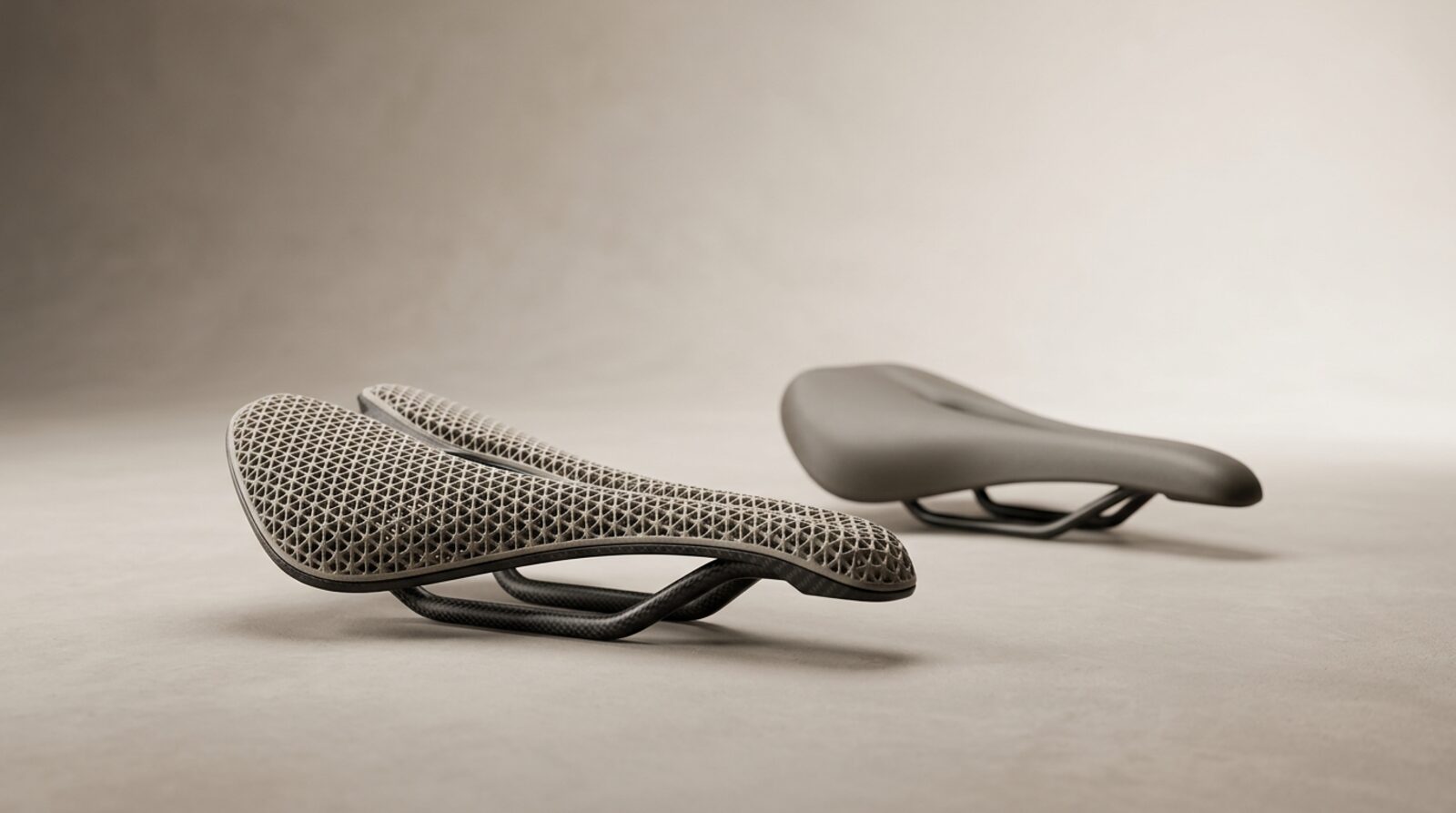
At the sourcing stage, more bicycle brands, distributors, and private label buyers are now comparing 3D printed bicycle saddles directly against conventional foam-padded saddles. A few years ago this comparison rarely came up — 3D printed saddles were treated as a separate, niche category. Today they sit on the same shortlist as conventional models in the majority of OEM briefings.
Several things have changed at the same time. The 3D printed format has matured technically and is now reliable enough to ship in volume. Buyers see competing brands launching 3D printed flagship models and want to understand whether they should follow. End customers in performance and premium segments increasingly recognise the format on sight, which raises the commercial relevance for any lineup competing in those bands.
At the same time, conventional saddles are not standing still. Foam systems, cover materials, and shell tooling continue to improve, and the format remains the most cost-effective comfort solution across most volume segments. The question for a B2B buyer is no longer "is 3D printing ready" — it is "which format fits this specific lineup, channel, and rider segment best."
2. The Comparison Is Not Only About Comfort
Framing the decision as a comfort comparison is too narrow for a B2B sourcing context. A useful comparison runs across at least six dimensions:
- Product positioning — where the saddle sits in a price ladder, and whether it lifts or anchors the lineup.
- Premium logic — whether the format supports a higher retail price and a healthier margin band. Covered in depth in are 3D printed bicycle saddles really worth the premium.
- Channel fit — whether the channels you actually sell through reward visible technology, or reward predictable price.
- Visual differentiation — how distinctive the product looks on a shop floor, in a catalogue, or on a product detail page.
- Repeat-order confidence — how stable batch-to-batch production is, and how predictable repeat orders feel.
- After-sales expectations — what dealers, distributors, and end customers expect in terms of warranty, returns, and long-term appearance.
A saddle that wins on comfort can still be the wrong commercial choice if it loses on most of these other dimensions. The sections below work through each side of the comparison with that broader frame in mind.
3. How 3D Printed Saddles Enhance Commercial Value in Premium Lineups
In the parts of a lineup where the goal is to lift perceived value, defend a higher price point, or carry the brand story, 3D printed saddles tend to be the more commercially efficient choice. The advantage shows up in five overlapping ways.
Premium positioning
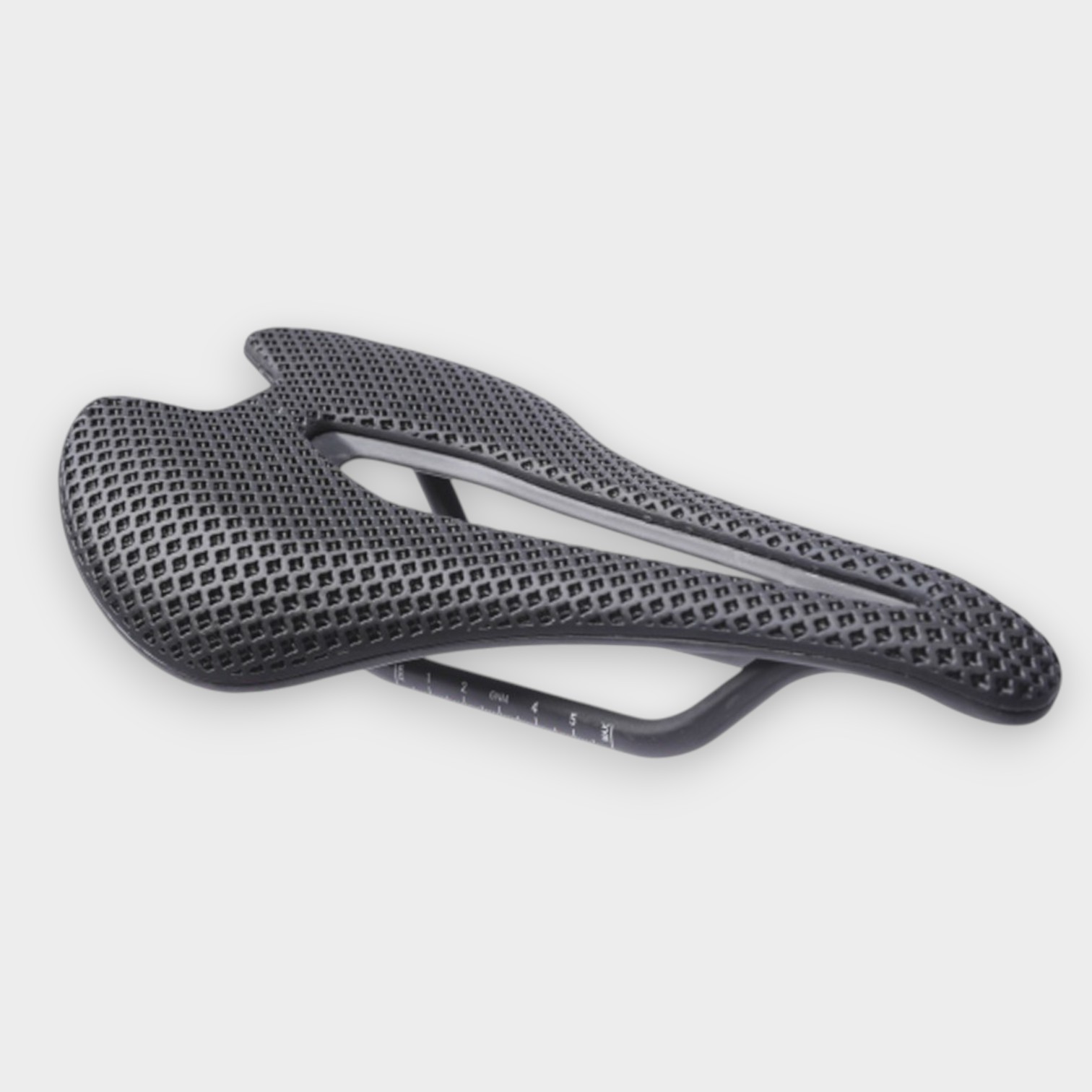
A 3D printed saddle credibly supports a higher retail price than a comparable conventional model. The format reads as engineered, modern, and technical — and that perception lets buyers anchor a flagship slot, a premium upgrade tier, or a halo SKU at a margin band that conventional saddles often struggle to defend. A full-carbon all-round platform like the K40 is a typical fit for this premium-tier slot.
Visible innovation
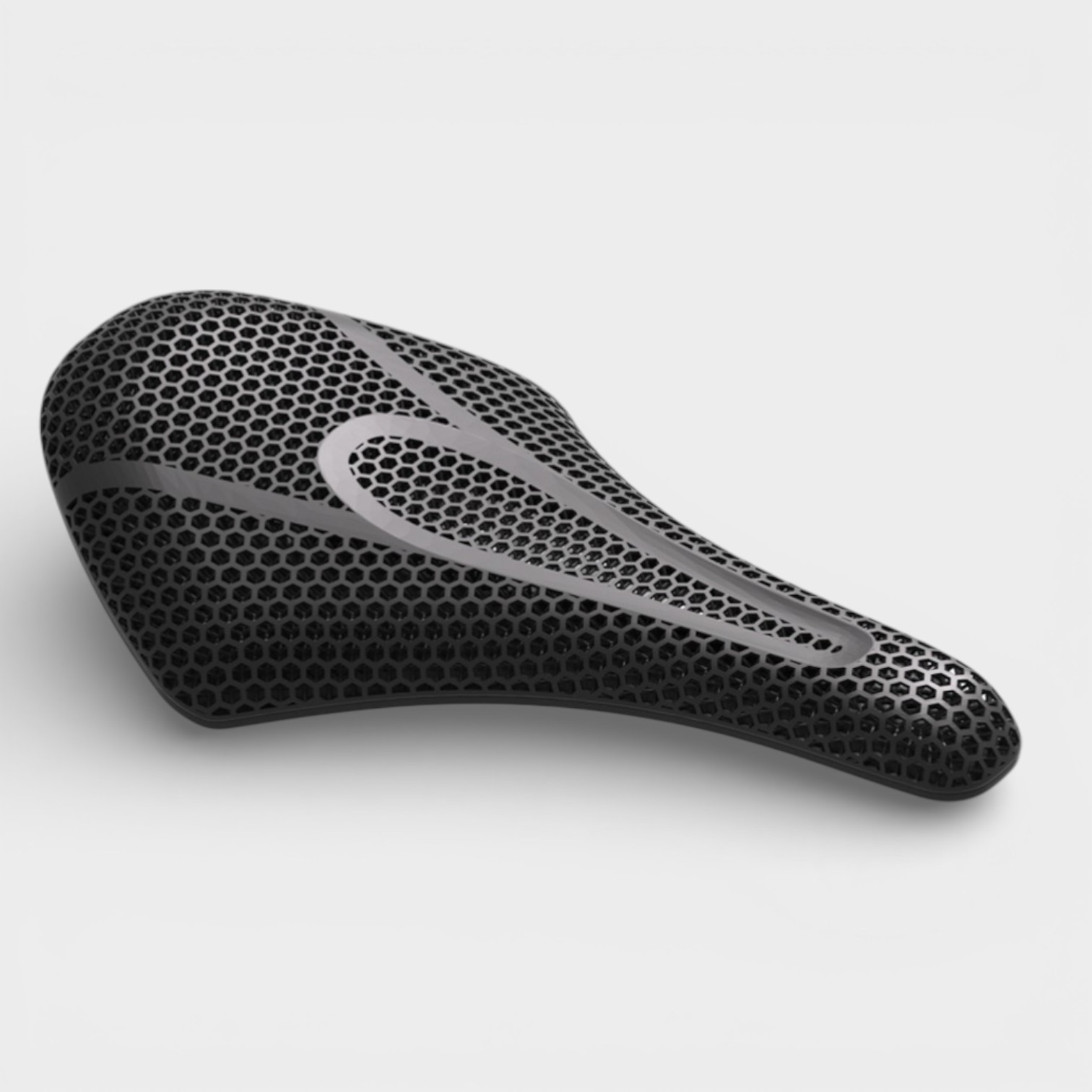
The lattice structure is immediately recognisable. End customers do not need to read a spec sheet to see that the product is different. For brands that need a single product on the floor or in the hero image to communicate "this is our advanced lineup," visible innovation is a real commercial asset.
Stronger product storytelling
A 3D printed model gives a brand more to say. Zoned cushioning, additive manufacturing, weight engineering, and material innovation all map cleanly into product copy, brand campaigns, and dealer training. Conventional saddles often have an equally strong technical story, but it is harder to make that story visible at first glance.
Flagship or hero SKU potential
A 3D printed saddle is well suited to the role of a hero SKU — a single model that sets the tone for the rest of the lineup, anchors the brand's premium edge, and gives sales teams a model to lead with. The format carries a clear "this is our top tier" signal even when the rest of the catalogue is more traditional.
Differentiation in crowded product lines
In categories where dozens of similar-looking saddles compete on shape and price, a 3D printed model breaks the visual pattern. For brands and distributors trying to avoid a generic lineup — or trying to give a private label program a clear identity — that differentiation can be commercially decisive.
4. Where Conventional Saddles Still Make More Commercial Sense
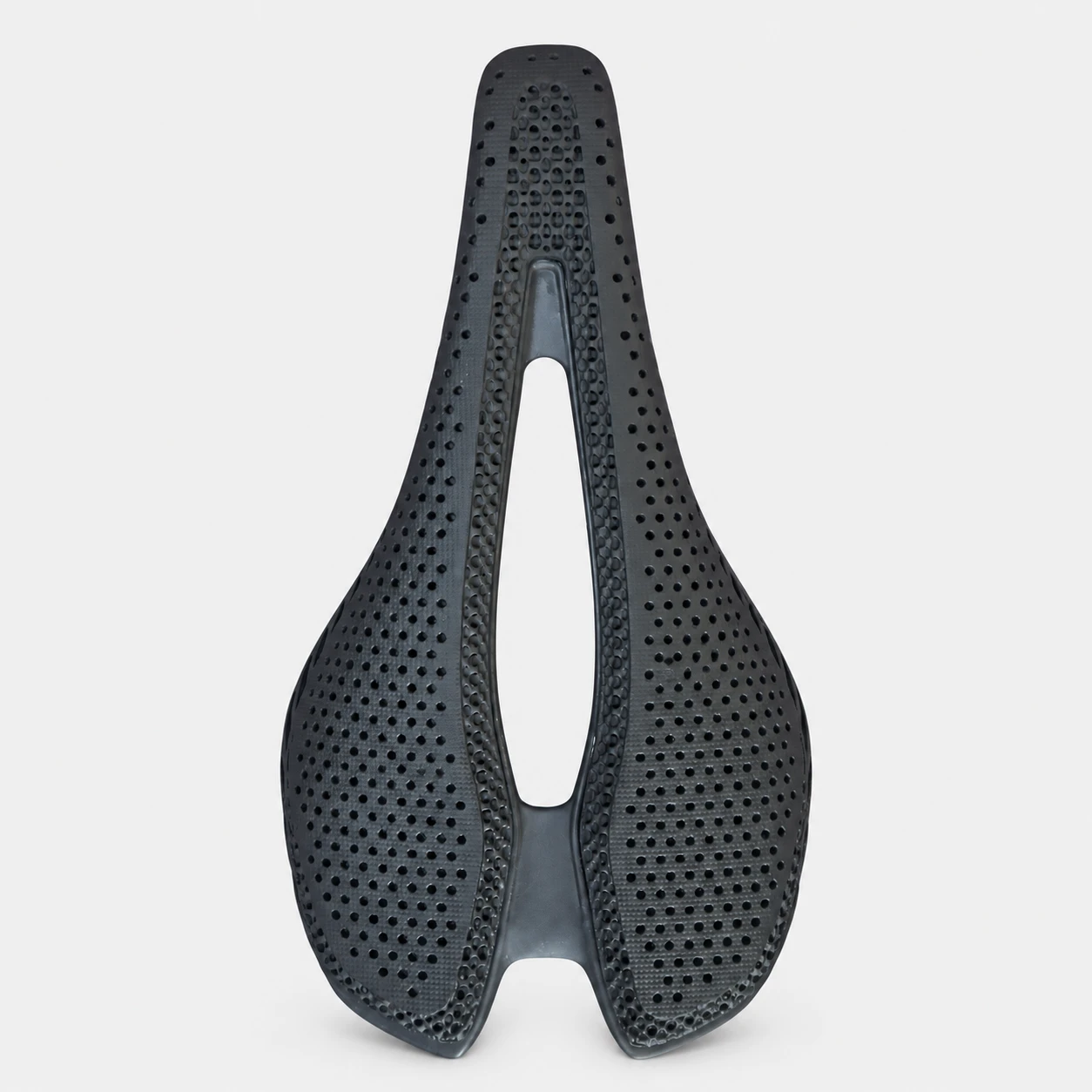
For large parts of most lineups, a conventional saddle is still the more sensible commercial choice. The format has decades of refinement behind it, the supply base is broad and competitive, and the customer base already knows what to expect. There are five situations where this is especially clear.
Price-sensitive channels
In channels where the buying decision is driven mainly by retail price — mass retail, value e-commerce, certain regional distribution networks — a 3D printed saddle rarely earns back its premium. Conventional saddles deliver the comfort, fit, and durability these customers expect at a price point the channel can actually convert.
Simple entry-level product lines
Entry-level bikes and entry-level saddle SKUs do not need engineered cushioning to perform commercially. They need a familiar shape, a durable cover, a competitive cost, and reliable supply. Conventional saddles fit that brief naturally.
Broad-volume distribution
Where unit volume is the primary commercial goal — large container programs, multi-region distributors, OEM bike spec at scale — conventional saddles offer the cost predictability, MOQ flexibility, and supply depth needed to support that scale. 3D printed saddles can support volume too, but rarely as cleanly across many low-cost SKUs.
Lower customer education requirements
A conventional saddle does not need a sales conversation. Customers, dealers, and distributors already understand what foam, cover, and rail combinations mean. A 3D printed saddle, by contrast, often benefits from explanation — and in channels where there is no time or budget for that conversation, the conventional format wins by default.
Easier retail sell-through in basic segments
For commuter, urban, comfort, and entry-level performance saddles, retail sell-through is faster when the product looks familiar and prices in line with peer models. Conventional saddles meet that expectation, while a 3D printed saddle in the same band can confuse the price story rather than help it.
5. Comfort and Ride Feel: What Buyers Should and Should Not Assume
Comfort is the single most over-assumed dimension in this comparison. A 3D printed saddle is not automatically more comfortable than a conventional one, and a conventional saddle is not automatically less refined.
What 3D printed saddles do offer is more spatial precision in pressure management. Lattice density can be tuned by zone — firmer at the sit-bone area, softer at the perineal channel, independently calibrated at the nose — which gives more control over how pressure is distributed during longer rides. For performance riders and longer-distance use cases, this can be a meaningful advantage.
What 3D printed saddles do not change is the more fundamental comfort variables: shape, platform width, rider fit, and intended use. A 3D printed saddle on the wrong shape for the rider will still be uncomfortable. A conventional saddle on the right shape, with appropriate foam density, can outperform a poorly matched 3D printed model in real-world riding.
For B2B buyers, the practical implication is that the comfort comparison should always run after the fit and use case is defined — never before. Choose the shape and platform first, then choose the cushioning format that fits the role. Buyers who skip that step often end up promoting "comfort" as a feature when the underlying fit was wrong for the segment.
6. Durability, Cleaning, and Maintenance Differences
Both formats can be engineered for multi-season life, but they age and clean differently — and those differences matter to buyers planning long-term programs.
Long-term appearance
Conventional saddles tend to age in predictable, well-understood ways: the cover may show edge wear, the foam may compress slightly under heavy use, and high-friction areas may polish over time. 3D printed saddles tend to keep a more consistent visual identity over time — the lattice does not "wear in" the way foam compresses — but surface marks, scuffs, or staining on the lattice can be more visible because there is no cover layer to hide them.
Cleaning practicality
Conventional saddles are quick to clean — a wipe of the cover handles most situations. 3D printed saddles are also straightforward to clean but benefit from a softer brush around the lattice openings, especially in muddy or sandy use. For commuter and gravel programs, this is worth flagging in dealer training rather than assumed.
Surface wear perception
Customer perception of wear is not the same as actual wear. A conventional saddle with a slightly polished cover often "looks used" earlier than a 3D printed saddle with the same kilometres on it. Conversely, a small mark on a 3D printed lattice can be more noticeable at first glance even if the structural integrity is unchanged. Both perceptions affect after-sales and resale conversations.
Batch consistency concerns
Conventional saddle batch consistency is governed by mature processes — foam density, cover cutting, rail bonding — and well-controlled in established factories. 3D printed saddles are more sensitive to process drift across batches, particularly in lattice density, surface finish, and rail bonding. The supplier's ability to govern repeat production is a more critical sourcing variable than it is for conventional saddles.
Use-case expectations
Realistic durability also depends on the use case. In road and gravel use, both formats handle multi-season programs well when matched to a rider segment. In commuter and urban use, conventional saddles are usually the safer commercial bet — exposure to weather, theft risk, and replacement-cycle expectations all favour a lower-cost, easily replaced product. For deeper detail on the long-term picture, see whether 3D printed bicycle saddles hold up over time.
7. Sourcing and Operational Differences
For many buyers, this is where the comparison becomes practical rather than theoretical. Beyond the product itself, the two formats behave very differently in day-to-day sourcing and operations — and these differences often shape the final decision more than ride feel does. A structured OEM development process helps surface most of them before a program is committed.
MOQ expectations
Conventional saddles support lower MOQs per variant and high SKU elasticity — many shapes, widths, covers, and rail tiers can run from a shared platform. 3D printed saddles tend to require higher MOQs per configuration because each meaningful variant has to be validated. This favours a focused 3D printed lineup rather than a wide one.
Sampling importance
For conventional saddles, sampling is a confirmation step. For 3D printed saddles, sampling is a decision step — surface finish, lattice density, and shell-rail integration should all be evaluated on a physical sample before committing to a program. Buyers who skip detailed sampling on 3D printed sourcing tend to discover misalignments only in repeat production.
Product consistency
Conventional production is more forgiving of small process variations. 3D printed production needs governed process control to keep batches consistent in lattice density, dimensional accuracy, and bonding. The sourcing question is not whether a supplier can make a single good saddle, but whether they can make the tenth thousand identical to the first.
Private label feasibility
Both formats support private label, but the structure differs. Conventional private label is broad and elastic — multiple SKUs across a shape family with light branding. 3D printed private label is typically narrower and more distinctive — a single hero SKU with a unique shell, branded lattice pattern, and tightly controlled spec. The companion guide on private label saddle programs covers this in more depth.
Communication burden in sales channels
Conventional saddles need almost no explanation in the channel — dealers, distributors, and end customers know what they are buying. 3D printed saddles benefit from product training, dealer-facing collateral, and an explicit price-justification story. Buyers who do not budget for that communication often see slower sell-through in the first season.
Warranty and return handling
Conventional saddle warranty cases tend to be familiar — cover wear, foam compression, rail issues — and dealers know how to handle them. 3D printed saddle warranty cases are more variable: lattice marks, surface scuffs, perceived versus actual wear, and the supplier's ability to evaluate returns from photographs. Choosing a supplier with clear after-sales protocols matters more for the 3D printed format than it does for the conventional one.
8. A Simple B2B Decision Framework
Once the comparison runs across positioning, channel, comfort, durability, and sourcing, most B2B decisions fall into one of three patterns:
Choose 3D printed if…
- The model needs to anchor a flagship, premium, or innovation-led slot in the lineup.
- The channel rewards visible technology and supports a higher retail price band.
- The brand needs a single hero SKU to lift the perceived value of the rest of the range.
- A private label program needs a distinctive product that stands out from generic competitors.
- The target rider is performance-oriented, longer-distance, or expects engineered cushioning.
Choose conventional if…
- The model needs to carry volume across price-sensitive channels.
- The lineup needs many SKUs from a shared shell platform with low MOQ per variant.
- The target rider is commuter, urban, or entry-level performance.
- The channel does not have time or budget for product education at point of sale.
- Predictable cost, broad supply base, and easy after-sales handling matter more than visible innovation.
Test both if…
- The lineup spans both volume and premium positions, and a combined approach is realistic.
- Channel mix is split between price-driven and specialty / DTC outlets.
- The brand is preparing a multi-tier private label program — a 3D printed hero SKU plus a conventional volume range.
- End-customer feedback on a 3D printed pilot is needed before committing to a wider rollout.
9. Conclusion
The comparison between 3D printed and conventional bicycle saddles is not a contest between an old format and a new one. Both are mature, both can be fully customised, and both can support strong long-term programs when the format is matched to the role.
The right choice depends on channel, positioning, target rider, and business model — not on which format is currently trending. Buyers who define the role first and choose the format second tend to build healthier lineups than buyers who lead with technology and try to retrofit the commercial logic afterwards.
Two related guides go deeper on the 3D printed side of this decision: are 3D printed bicycle saddles really worth the premium works through the price and channel logic, and why more bicycle brands are paying attention to 3D printed saddles covers the positioning and product-line strategy. To go straight to product, the 3D printed saddle range and the conventional saddle range list every model currently available for OEM and private label projects.
Looking at both 3D printed and conventional saddle options for your lineup?
Share your target market, intended channel, target price range, and product direction. We can help compare suitable saddle platforms for your project.
Platforms commonly shortlisted