3D Printed Bicycle Saddle Cost: What Drives an OEM Quote?
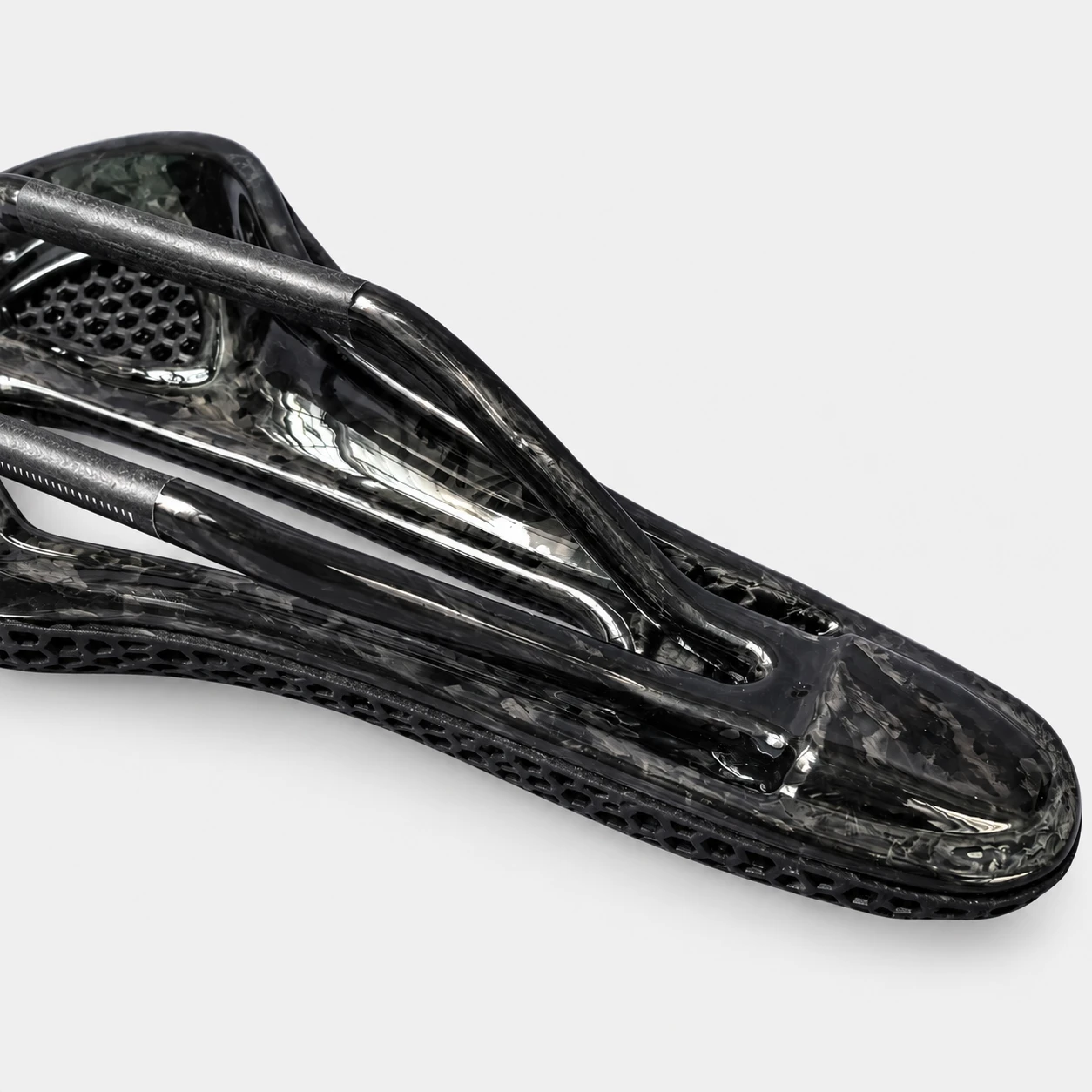
Two 3D printed bicycle saddles can look almost identical in photographs and still receive very different OEM quotations.
One may use a carbon base and carbon rails. Another may have a reinforced nylon base and Chromoly rails. The printed uppers may also differ in material, lattice construction or production requirements.
If both quotations simply describe the product as a “3D printed bicycle saddle,” the difference in price tells you very little. Before negotiating, it is worth establishing whether the suppliers are actually quoting the same configuration.
This guide looks at the main cost factors, what changes with order quantity, and the details an overseas buyer should check before comparing quotations.
Where the Cost Comes From
A finished 3D printed saddle involves more than printing the cushioning surface. For most OEM projects, the quotation needs to account for five areas:
| Cost area | What affects it |
|---|---|
| 3D printed upper | Material, lattice design, printing process and production requirements |
| Saddle base | Material, construction, geometry and tooling |
| Rails | Material, dimensions, geometry and compatibility |
| Assembly and finishing | Joining, branding, inspection and finishing work |
| Project requirements | Sampling, development, MOQ, packaging, testing and delivery terms |
There is no fixed percentage that each area contributes to the final cost. The balance changes with the saddle platform, the quantity and the amount of customization involved.
A useful quotation should make the product configuration and included services clear, even if the supplier does not disclose its internal manufacturing costs.
The Printed Upper Is Only One Part of the Price
The 3D printed lattice attracts most of the attention, but it is not enough to judge production cost from a photograph. The actual manufacturing process matters.
Depending on the production technology, cost can be affected by the selected material, lattice geometry, equipment utilization, post-processing, inspection and production yield.
Buyers sometimes assume that a denser lattice must be more expensive, or that a softer lattice must take longer to print. These are not reliable rules across every additive manufacturing process. A particular lattice design may require more development or affect production efficiency, but the cost effect needs to be checked against the actual process.
There is also a practical limit to how much technical information a supplier can reasonably disclose. Detailed machine programs and proprietary printing parameters may not be available to buyers. What should be available is a clear product specification, an approved reference sample and agreed acceptance criteria.
When a revised quotation comes back much lower, ask whether the upper construction is still the same as the sample you approved. That question is usually more useful than asking for a general discount.
Base Construction Changes the Quotation
The base supports the saddle structure and connects the upper to the rails. In SPROKETO’s product range, different platforms use carbon, nylon-fiber and carbon-reinforced nylon constructions. These are not equivalent specifications.
A carbon-based saddle and a reinforced nylon-based saddle may serve different weight targets, structural designs and market positions. Their manufacturing and tooling requirements may also differ. However, material names alone cannot tell you the exact price difference.
The base geometry matters, as does whether the factory can use an existing platform or needs to develop a new structure. An existing base may already have established tooling and production arrangements. A completely new base can involve additional design work, sampling and dedicated tooling.
For this reason, buyers should confirm both the base material and whether the quoted product uses an existing or newly developed structure. For a more detailed comparison, see our Carbon Base vs Nylon Base Bicycle Saddles guide.
Rail Material Can Change the Product’s Price Position
Rail selection is another reason apparently similar saddles receive different quotations. A lightweight premium version may use carbon rails, while a more accessible configuration may use Chromoly rails.
But it is not enough for a quotation to state only “carbon rail” or “metal rail.” The rail dimensions and geometry should also be confirmed. For example, a 7 × 7 mm round metal rail and a 7 × 9 mm oval carbon rail may require different compatible seatpost clamping hardware.
That is a practical issue for brands selling through aftermarket channels, where the customer may already own a seatpost.
If a supplier proposes a cheaper rail, the buyer should check three things:
- Has the material changed?
- Have the rail dimensions or geometry changed?
- Does the revised configuration still meet the intended product and compatibility requirements?
Changing the rail may be a reasonable way to create another price level. It should be an intentional product decision, not an unnoticed change between quotations. For more detail, see Carbon vs CrMo Bicycle Saddle Rails: How OEM Buyers Should Choose.
Assembly, Branding and Finishing Still Have a Cost
The printed upper and saddle base still need to become a finished product. Depending on the construction, this may involve joining the upper and base, fitting the rails, finishing, inspection and packaging. For private-label projects, the quotation may also need to cover logo application, color requirements, labels and retail packaging.
One point worth checking is whether a quotation covers the complete assembled saddle or only certain components. Another is whether customization is included. A standard product with neutral packaging is not directly comparable to a customized version with branding, retail cartons and additional inspection requirements.
Also, not every 3D printed saddle has a conventional fabric or leather cover. Some designs use an exposed printed lattice surface. The finishing requirements should follow the actual construction rather than a generic saddle specification.
Does 3D Printing Remove Tooling Costs?
Not for the complete saddle.
Depending on the manufacturing method, the printed cushioning upper may not require a dedicated shape-specific mould. That does not mean the base, structural components or assembly process will be free of tooling requirements.
This distinction becomes especially important when a brand is deciding between an existing platform and a new design. Starting with an existing platform may reduce development work if the geometry and construction already meet the project requirements. A modified platform can involve additional sampling or changes to selected components. A fully custom design may require new structural tooling, prototype approval and further development work.
Before committing to a project, ask the supplier to separate the unit price from any applicable sample, development and tooling charges. It is also worth confirming whether a charge is one-time, recurring or dependent on the final design.
Three Real Saddle Configurations
Looking at actual products helps explain why a general description such as “3D printed saddle” is not enough for a price comparison. The following are three configurations from SPROKETO’s range.
| Model | Base | Rail | Size | Complete weight |
|---|---|---|---|---|
| 665 | Carbon | Carbon | 248 × 148 mm | 177 ± 10 g |
| K06 | Carbon | Carbon | 253 × 143 mm | 205 ± 10 g |
| K08 | Nylon Fiber | Chromoly, 7 × 7 mm | 245 × 145 mm | 257 ± 10 g |
All three use 3D printed saddle construction, but they are not the same product. The 665 and K06 both have carbon bases and carbon rails, yet their dimensions and complete weights differ. K08 uses a different base and rail configuration.
These figures do not show which product costs more. That would require actual quotations under comparable commercial conditions. They show why a buyer should identify the specific model and configuration before comparing prices.
What Happens to the Unit Price When Quantity Increases?
Larger orders can improve purchasing and production efficiency, but the effect is not the same for every saddle project.
Potential savings may come from buying materials in larger quantities, reducing changeovers, spreading setup expenses and improving production planning. Packaging and logistics can also become more efficient. Other costs remain tied to each unit produced. The saddle still needs to be manufactured, assembled, inspected and packed.
For that reason, it is better to request several quotation tiers than assume a particular discount based on MOQ. Ask the supplier to quote the same configuration at different quantities, keeping the rail, base, printed upper and packaging requirements unchanged. Otherwise, a lower unit price may come from a different specification rather than the larger order.
If the project involves new tooling, compare the one-time development cost separately from the recurring product cost. This gives a more realistic view of the total project investment.
How to Compare Two Quotes Properly
Before comparing unit prices, put the main specifications and terms side by side. The following items are worth checking:
| Item | What to confirm |
|---|---|
| Product | Model number, drawing or approved reference |
| Printed upper | Material and agreed construction |
| Base | Material and structural configuration |
| Rail | Material, dimensions and geometry |
| Weight | Complete weight and tolerance |
| Customization | Logo, color, labels and packaging |
| Quantity | MOQ and quoted volume |
| Development | Sample, programming and tooling charges where applicable |
| Quality | Inspection and testing scope |
| Delivery | Production lead time, Incoterm and named place |
On the quality line, testing documentation applies to the configuration that was tested, so it is worth confirming which model and construction a report covers. Our guide to Bicycle Saddle Testing for OEM Buyers explains how to read that scope.
A quotation may appear cheaper because packaging is excluded, because the rail is different or because one-time development fees are listed separately. These are not necessarily problems, provided the scope is clear. The difficulty begins when two prices are compared without checking what each supplier has included.
For overseas buyers, the quoted unit price is also not the same as the landed cost. The agreed Incoterm, transport arrangement, carton dimensions and destination charges need to be considered separately.
Common Mistakes That Make Quotes Difficult to Compare
Several problems appear repeatedly in saddle sourcing discussions.
Comparing photographs rather than specifications. Similar product images do not prove that the printed upper, base and rails are identical.
Focusing only on weight. A lighter saddle is not automatically cheaper or more suitable. Weight needs to be considered together with the complete construction and intended market.
Overlooking rail dimensions. Material and cross-section both matter, especially for seatpost clamp compatibility.
Assuming an approved sample guarantees repeat production. Buyers still need documented specifications and acceptance criteria, supported by production quality control.
Ignoring excluded charges. Development, tooling, branding, retail packaging and transportation may not all be included in the initial unit price.
Most of these issues can be avoided by agreeing on the product configuration before asking several suppliers to quote it.
What to Include in an OEM Saddle RFQ
You do not need a finished engineering drawing to begin a discussion with a manufacturer. However, a useful RFQ should describe the product you intend to sell. Include:
- Intended bicycle application and target customer
- Target market and product price segment
- Existing saddle model reference or required dimensions
- Preferred printed upper construction, if known
- Base material preference
- Rail material and dimensions
- Target complete weight and acceptable tolerance
- Logo, color and packaging requirements
- Initial order quantity and expected repeat orders
- Quality and testing requirements
- Delivery destination and preferred Incoterm
If some choices are still open, say so. That allows the supplier to suggest an existing platform or identify which parts require development.
For customized projects, review SPROKETO’s OEM Bicycle Saddle Development process.
Frequently Asked Questions
Why do similar 3D printed bicycle saddles have different prices?
They may use different printed uppers, base materials, rail configurations or assembly requirements. Order quantity, tooling, branding and packaging can also change the quotation. A fair comparison requires the same product specification and commercial scope.
Is 3D printing always more expensive than conventional foam construction?
Not necessarily for every project. Unit production costs, tooling, quantity and customization all matter. The comparison should be based on the complete project rather than the cushioning material alone.
Does a 3D printed bicycle saddle require a mould?
The printed upper may not require a dedicated shape-specific mould, depending on the manufacturing process. Other parts of the saddle, particularly a new base or structural component, may still require tooling.
Will increasing MOQ significantly reduce unit price?
It may improve purchasing and production efficiency, but the amount depends on the project. Ask for volume-based quotations using the same specification rather than assuming a fixed discount.
What should I send to get an accurate OEM quotation?
Provide the target application, product dimensions, preferred base and rail, complete weight target, customization requirements, estimated quantity and delivery terms. A model reference or drawing will help make the quotation more specific.
Final Thoughts
A 3D printed bicycle saddle quotation is only useful when the buyer understands what is being supplied. The printed upper matters, but so do the base, rails, assembly, tooling, quality requirements and delivery terms.
Before selecting a supplier, make sure the configuration is clear and the quotations cover equivalent products. That makes it easier to judge cost, identify reasonable alternatives and avoid specification changes after sampling.
Developing a 3D Printed Saddle Program?
Send SPROKETO your preferred saddle model, dimensions, base and rail requirements, weight target, price positioning and estimated quantity.
We can review the available platform options and clarify what needs to be confirmed before preparing a project-specific quotation.