3D Printed Bicycle Saddles in 2026: What OEM Buyers Should Evaluate
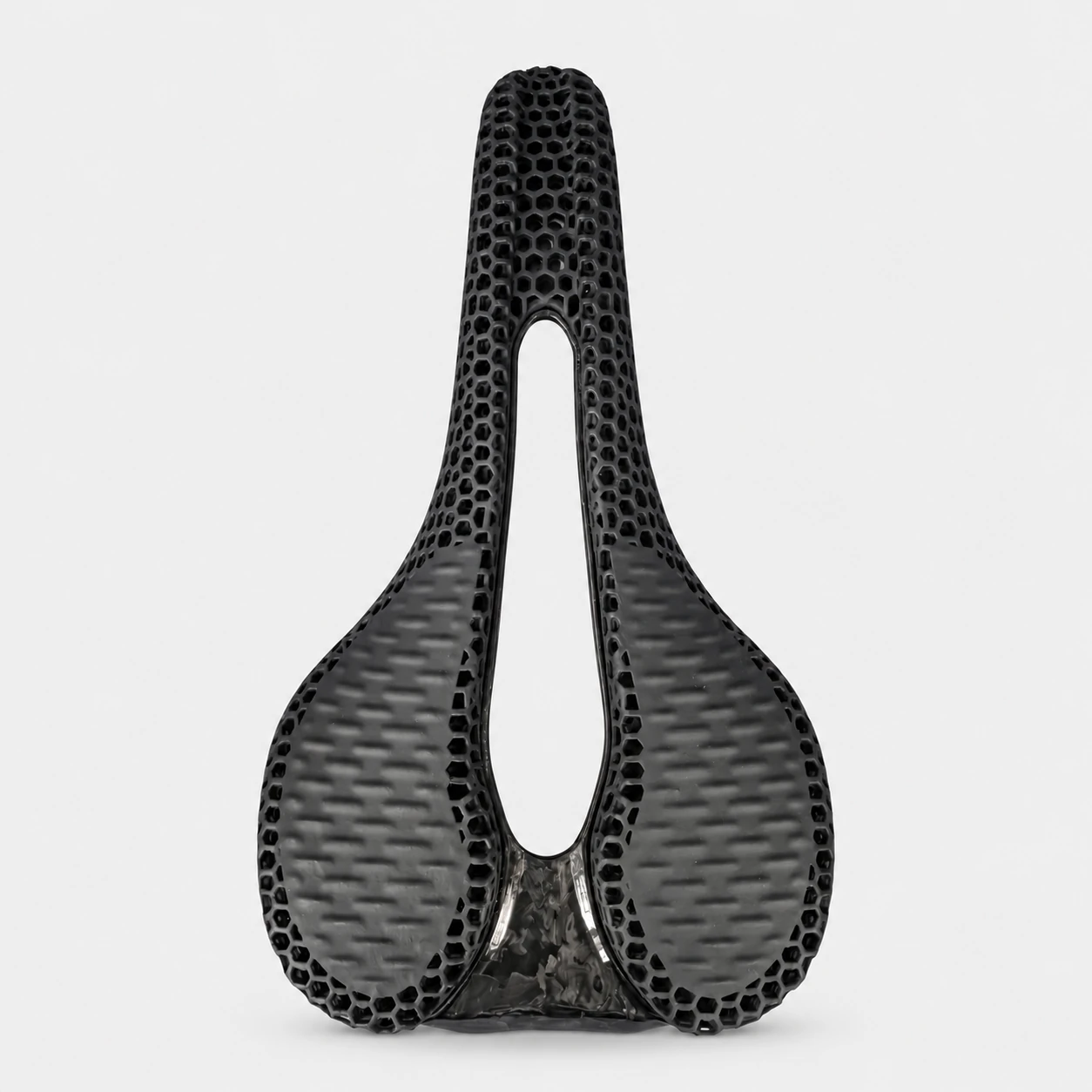
3D printed bicycle saddles are no longer interesting simply because they are 3D printed.
By 2026, the technology has become established across premium road, gravel and performance saddle ranges, with brands using different shapes, widths, rail systems and even personalized fit approaches.
For an OEM buyer, this changes the sourcing question.
The question is no longer:
“Should we launch a 3D printed saddle?”
It is:
“Which 3D printed saddle configuration is right for our market, price point and rider?”
A 3D printed upper alone does not define the final saddle.
The finished product is the result of several decisions working together:
- lattice structure
- saddle geometry
- base construction
- rail material
- rail dimensions
- saddle width
- target complete weight
- production tolerance
- testing requirements
- target retail position
For bicycle brands and private-label buyers, these decisions matter much more than the visual novelty of the lattice.
1. Start With the Product Brief, Not the Lattice
A weak OEM brief starts with:
“We want a 3D printed saddle.”
A useful brief starts with:
- Who is the target rider?
- Road, gravel, MTB or another application?
- What retail price segment are we targeting?
- What complete saddle weight do we want?
- Is the product premium, mid-range or entry-level?
- Which rail direction makes sense?
- Which base construction fits the project?
- Are we using an existing platform or developing something new?
This matters because two 3D printed saddles can look similar but belong to completely different commercial positions.
One may combine a carbon base and carbon rail for a lightweight premium SKU.
Another may use a reinforced nylon base and metal rail for a more accessible price point.
Both are still 3D printed saddles.
The complete configuration determines the product.
2. Evaluate the Lattice as a Functional Structure
The lattice is the most visible part of a 3D printed saddle, but appearance alone tells an OEM buyer very little.
A better evaluation looks at questions such as:
- Are different areas of the saddle designed with different lattice characteristics?
- How does the nose area differ from the rear support area?
- How open or closed is the structure?
- Is the lattice easy to clean?
- Does the surface suit the intended riding environment?
- Is the lattice appearance consistent from sample to sample?
Current premium 3D printed saddle systems can use zonal structures rather than treating the entire surface as one uniform cushion.
The sourcing lesson is simple:
Do not specify only “3D printed upper.”
The lattice needs to be evaluated as part of the final product.
If repeated-load performance is important, it should be evaluated through the final sample, production controls and any testing requirements relevant to the project rather than inferred from lattice appearance alone.
3. 3D Printed Does Not Automatically Mean Lightweight
This is one of the most important points for OEM buyers.
A 3D printed surface can be used in a lightweight saddle.
But the printing technology alone does not determine the final weight.
Complete saddle weight also depends on:
- lattice volume
- saddle dimensions
- base material
- rail material
- hardware
- rail-to-base structure
- overall geometry
This is why two saddles in the same 3D printed category can have substantially different finished weights.
Real Configuration Examples
SPROKETO’s own products illustrate the point:
| Model | Base | Rail | Size | Weight |
|---|---|---|---|---|
| 665 | Carbon | Carbon | 248 × 148 mm | 177 ± 10 g |
| K06 | Carbon | Carbon | 253 × 143 mm | 205 ± 10 g |
| K08 | Nylon Fiber | Chromoly 7 × 7 mm | 245 × 145 mm | 257 ± 10 g |
These are all 3D printed saddle configurations, but their complete constructions are different.
Across OEM saddle development, visually similar 3D printed platforms can lead to different final weights and market positions once the base, rail, dimensions and complete construction are changed.
That is why an RFQ should specify target complete saddle weight rather than assuming that ‘3D printed’ automatically means ultralight.
4. Base Construction Changes the Product Architecture
The base is one of the most important structural choices in an OEM saddle project.
Depending on the platform, directions may include:
- carbon base
- carbon-reinforced nylon
- nylon-fiber construction
These should not be reduced to a simple “good / better / best” hierarchy.
Different base constructions support different combinations of:
- weight
- cost
- product positioning
- structure
- tooling
- target application
A premium lightweight program may favor a carbon-based configuration.
A more cost-sensitive range may use a reinforced nylon direction.
The right choice depends on the product brief.
For an OEM buyer, the 3D printed surface and the saddle base should therefore be evaluated together. For a closer comparison, see Carbon Base vs Nylon Base Bicycle Saddles.
5. Rail Choice Is a Product-Positioning Decision
Rail material can change the commercial identity of the saddle.
Typical directions include:
- carbon rail
- CrMo / Chromoly rail
- other metal-rail configurations
Carbon rails are normally most relevant when low weight and premium positioning are important.
Metal rails can support a different cost and market position.
But rail choice affects more than weight.
It can influence:
- target retail price
- overall saddle weight
- product tier
- compatibility
- rail dimensions
- base interface
- testing requirements
This is why brands should think in terms of configurations rather than individual parts.
For example:
Premium Configuration
- 3D printed upper
- carbon base
- carbon rail
- lower complete weight target
More Accessible Configuration
- 3D printed upper
- reinforced base
- metal rail
- higher complete weight
- lower target price
The second version is not necessarily an inferior product.
It serves a different market.
For a deeper look at rail selection, see Carbon vs CrMo Bicycle Saddle Rails.
6. Geometry Still Matters More Than the Technology Label
3D printing does not fix a poor saddle-shape decision.
A saddle can use an advanced lattice and still be unsuitable for a particular rider or riding position.
OEM buyers should continue to evaluate:
- width
- length
- profile
- nose shape
- central relief
- rear support area
- rider position
- intended bike category
Premium 3D printed saddle products continue to be offered in different widths and shape concepts because the upper technology does not replace the need for a defined fit and application strategy.
So the correct sequence is:
application → geometry → construction → lattice
not:
lattice → everything else
7. Avoid Universal Comfort Claims
“Comfortable” is not a complete product specification.
Comfort varies with:
- rider anatomy
- sit-bone width
- riding position
- bike geometry
- saddle angle
- ride duration
- personal preference
OEM buyers should therefore be careful with marketing claims such as:
- fits every rider
- maximum comfort
- eliminates pressure
- the most comfortable saddle
unless there is strong evidence for the exact claim.
A more credible product page explains:
- intended application
- saddle width
- shape
- rail
- base
- construction
- target rider
Specific product information is more useful than broad comfort language.
8. A Good Sample Is Not Enough — Production Consistency Matters
An impressive first sample does not guarantee a successful production run.
For 3D printed saddle projects, buyers should evaluate whether production can consistently maintain:
- saddle dimensions
- lattice consistency and integrity
- base geometry
- rail position
- bonding / assembly
- complete saddle weight
- color
- surface finish
The approved sample should become a production reference.
This matters even more for repeat orders.
If the second production run differs from the first in material configuration, weight, rail or appearance, the buyer may end up selling different products under the same SKU.
That is why sample approval and production consistency should be treated as separate stages, supported by structured quality control.
9. Specify Weight Tolerance, Not Only One Weight Number
An OEM specification should distinguish between:
- nominal weight
- approved sample weight
- production tolerance
- mass-production acceptance range
For example:
177 ± 10 g
does not mean that every unit will weigh exactly 177 g.
The tolerance is part of the specification.
This matters especially when low weight is part of the product positioning.
Brands should therefore confirm the expected weight range before mass production rather than discovering variation after the product is launched.
10. Testing Should Follow the Final Configuration
A saddle should be evaluated as a complete assembly.
Changing the:
- rail
- base
- rail geometry
- connection structure
can create a materially different product configuration.
OEM buyers should not assume that one test result automatically covers every variation.
SPROKETO has third-party testing documentation for a tested K06 configuration, covering applicable saddle security, static-strength and fatigue requirements referenced in the testing documentation.
The documentation applies to the tested K06 configuration and should not be interpreted as certification of SPROKETO, other K06 configurations, or the complete saddle range. See Bicycle Saddle Testing for OEM Buyers.
This distinction is important for both sourcing and compliance communication.
11. Decide Whether to Start From a Platform or From Zero
Not every 3D printed saddle project requires a completely new design.
An OEM buyer typically has three development directions.
Existing Platform
Suitable when:
- development speed matters
- tooling investment should be limited
- an existing geometry fits the target market
Modified Existing Platform
Suitable when:
- the basic platform is appropriate
- selected structural or visual changes are required
- the brand wants more differentiation
Fully Customized Development
Suitable when:
- geometry is unique
- the base structure is new
- dedicated tooling is required
- the brand has a defined technical brief
This decision should be made before spending time on color, logo and packaging.
3D Printed Saddle Platforms
Explore Existing 3D Printed Saddle Platforms
For buyers who want to begin with an existing platform, SPROKETO offers multiple 3D printed saddle configurations using different base, rail, width and weight combinations.
View 3D Printed Saddle Platforms12. Compare Samples With a Buyer Scorecard
When several samples arrive, do not select the winner only by appearance.
Use a structured evaluation.
OEM Sample Evaluation Scorecard
Geometry
- length
- width
- profile
- nose
- central relief
Construction
- 3D printed upper
- base
- rail
- rail size
- connection structure
Weight
- complete sample weight
- target production tolerance
Surface Quality
- lattice consistency and integrity
- edge quality
- visual defects
- color consistency
Production Risk
- tooling requirements
- repeatability
- QC requirements
- testing requirements
This makes the final sample decision more objective and helps separate visual preference from production and sourcing risk.
13. What Should an OEM Buyer Include in the RFQ?
A useful RFQ should not simply say:
“We need a 3D printed saddle.”
It should include:
- intended bike category
- target rider
- target market
- saddle width
- saddle length
- preferred base
- preferred rail
- rail size if already defined
- target complete weight
- target price segment
- expected order quantity
- customization requirements
- testing requirements
- packaging requirements
The clearer the product brief, the easier it is to determine whether an existing platform can work or whether new development is required. Learn more about OEM bicycle saddle development.
Final Takeaway
In 2026, simply having a 3D printed saddle is no longer enough to differentiate a product.
The real competitive decision is the configuration.
OEM buyers should evaluate:
- who the saddle is for
- saddle geometry
- lattice strategy
- base construction
- rail configuration
- complete saddle weight
- production tolerance
- sample consistency
- testing requirements
- product price segment
The central sourcing principle is simple:
“A 3D printed upper alone does not define the final saddle.”
The strongest product programs start with the target market and complete product brief, then select the saddle platform and construction that support that position.
FAQ
Does a 3D printed bicycle saddle always weigh less than a conventional saddle?
No. Final saddle weight depends on the complete construction, including lattice volume, base, rail, saddle dimensions and connection structure.
What should OEM buyers evaluate in a 3D printed saddle lattice?
Evaluate the lattice as part of the complete product, including zonal structure, surface consistency, cleanliness, intended application and production repeatability rather than appearance alone.
Should an OEM buyer choose a carbon or reinforced nylon base?
It depends on the target product. Carbon can support a lightweight premium configuration, while reinforced nylon can support a different cost and market-positioning strategy.
Can one 3D printed saddle platform use different rail options?
Potentially, yes, but rail geometry, base structure, connection method, dimensions, complete saddle weight and testing requirements should be reviewed for each configuration.
What should an OEM buyer confirm before mass production?
Confirm the final geometry, upper construction, base, rail, rail size, target weight and tolerance, approved sample, QC requirements, testing requirements, branding and packaging.
Developing a 3D Printed Saddle Program?
Send us your target saddle dimensions, base and rail preference, target complete weight, market position and expected order quantity. We can help review whether an existing platform, modified platform or new development is the more suitable direction.